Can artificial intelligence help prepare graduates for tomorrow’s jobs?
Can artificial intelligence help prepare graduates for tomorrow’s jobs?
By Li Fengliang |
China Daily |
Updated: 2026-08-05 09:30


Share – WeChat
Artificial intelligence is rapidly reshaping the labor market, automating tasks such as routine copywriting, basic data analysis, conventional coding, repetitive administrative tasks and entry-level design work. As these jobs disappear or change, employers are increasingly demanding a different mix of skills from graduates
This transformation comes at a difficult moment for higher education. While the number of university graduates continues to grow, structural unemployment has become more pronounced
Under pressure to improve graduates’ job prospects, universities across China are restructuring their academic programs. Many institutions are introducing AI-related majors, promoting “AI plus X” interdisciplinary education or adopting broader admissions models
Responding to changes in the labor market is both reasonable and necessary. Universities cannot ignore technological, industrial and employment shifts. But they must also confront a harder question: Can they transform themselves quickly — and responsibly — to meet these new demands?
Building a robust academic program takes time. Universities need qualified faculty, coherent curricula, appropriate facilities and opportunities for practical training. These elements cannot be created simply by changing the name of a department or adding several technical courses
Without sufficient preparation, professional restructuring can easily become an emergency response to employment anxiety
Courses might focus narrowly on training students to use the latest tools, while education itself is reduced to preparing for currently available jobs. Though seemingly practical, such reforms risk creating deeper problems: an oversupply of similarly trained graduates, weak foundational knowledge, limited adaptability and a gradual erosion of the university’s educational mission
Introducing a new major does not automatically produce better talent. If universities rush into fashionable fields without understanding their intellectual foundations, required capabilities or real industrial demand, they may simply replace one mismatch with another
The problem is compounded by the speed of technological change
Technology often evolves faster than the university education cycle. A field that appears highly promising when students begin their degrees may have changed fundamentally by the time they graduate
Specific tools may become outdated, and established methods may be replaced by new technological paradigms
Universities that merely chase each new trend could therefore produce graduates who are doubly disadvantaged: lacking the depth of traditional disciplinary education and also unprepared for the next stage of technological change
Academic reform must therefore involve a deeper redesign of curricula, teaching methods and talent-development models
Rather than building isolated AI schools or programs, universities should develop strong “AI plus X” platforms. Artificial intelligence should be integrated with engineering, medicine, agriculture, the natural sciences, the humanities and the social sciences. This requires deeper cooperation between departments and breaking down long-standing barriers
The aim is not to turn every student into an AI specialist but to help students in different fields understand how intelligent technologies can reshape their disciplines, expand their analytical capabilities and solve real-world problems
Universities also need to strengthen cooperation with businesses, government agencies and research institutions. External partners can provide practical expertise, industrial re
Such cooperation can help connect the education chain, the talent chain and the industrial chain, reducing the gap between what students learn and what society actually needs
However, labor-market adaptation should not become the only purpose of universities. No matter how disruptive technology becomes, the fundamental responsibilities of education remain unchanged. Universities must cultivate moral character, foster independent thinking, transmit culture, encourage innovation and support the holistic development of the individual
Real education reform is not about blindly following technological trends. It requires universities to embrace innovation while maintaining a clear sense of what education is ultimately for
AI should be incorporated throughout teaching and learning. Students should learn to use intelligent tools effectively and responsibly. But universities must also place human development at the center of education. The more powerful technology becomes, the more important judgment, creativity, ethical responsibility and critical thinking will be
Universities can adjust their academic structures to meet national and social needs. At the same time, they must preserve the diversity of the academic ecosystem. Not every institution should establish the same programs, pursue the same fashionable disciplines or adopt the same development model
A wave of identical AI-related programs could lead to a new form of homogenization, in which universities lose their distinctive strengths while competing for the same students, teachers and reh every university begins to look the same
The rise of AI should be seen not merely as a disruption of higher education, but as an opportunity to reshape it
The primary task for universities is not to create more AI majors, but to reconsider what universities should teach — and how they should teach — in an age when information and technical assistance are increasingly easy to obtain
Knowledge acquisition alone can no longer define the value of university education. Students must learn how to evaluate knowledge, connect ideas across disciplines, identify meaningful problems and make responsible decisions. They must be able to work with machines without allowing machines to replace their own capacity for thought
The graduates best prepared for the AI era will not be those who have merely mastered the latest software. They will be those with strong disciplinary foundations, broad humanistic perspectives, the ability to use intelligent tools and the independence to question their outputs
Preparing such graduates is not only a practical response to employment pressure; it is essential to build a stronger education system and secure the country’s long-term development
The author is the deputy dean at the School of Education, Tsinghua University
The views don’t necessarily reflect those of China Daily
If you have a specific expertise, or would like to share your thought about our stories, then send us your writings at opinion@chinadaily.com.cn, and comment@chinadaily.com.cn
Japan’s remilitarization in the name of security
Middle East’s arduous journey toward peace
 Social media drives global embrace of Chinese culture
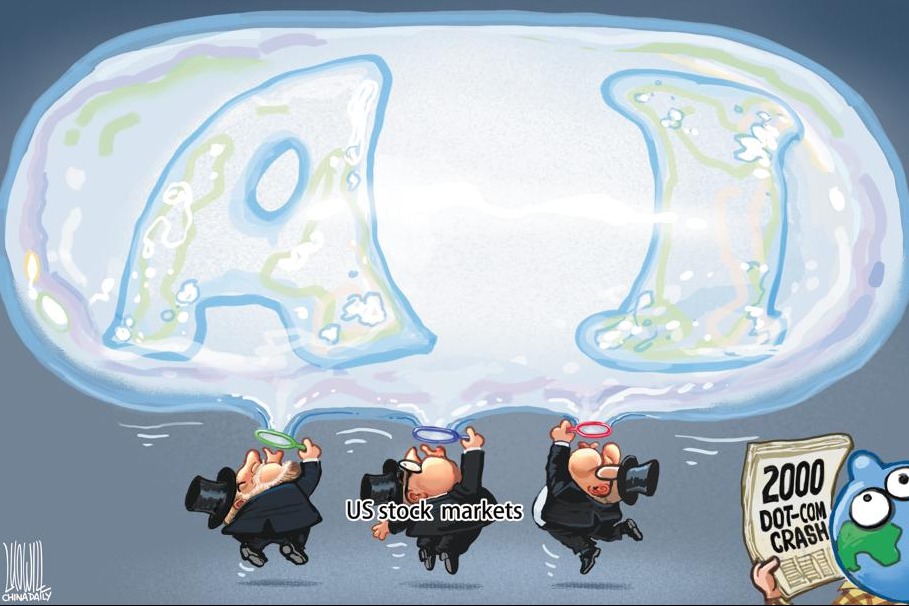 Cartoon: US AI stock bubble sparks dot-com crash fears
 Cartoon: NATO: Forget bread and roses, more bombs, please
Cartoon: Middle East conflict sends oil prices skyrocketing
Most Viewed in 24 Hours
Global Lens
Shenzhen’s journey from exports to expertise
Narrative a comforting illusion for bruised egos
Columnists+
About a bottle of tea that is not really my cup of tea
EU fines AliExpress 550m euros under Digital Services Act
Chinese Perspectives
Can artificial intelligence help prepare graduates for tomorrow’s jobs?
Clustering can rewrite the story of rural China
China and the World Roundtable+
Steering new dynamics in Asia-Pacific
Moving from AI race to AI governance
Need help choosing the right university or study destination?
Start your FREE JIUniversity Admission Assessment today and discover the best international study pathway for your academic goals.
Source: www.chinadaily.com.cn
Tag:artificial, graduates, help, intelligence, prepare

You may also like

Forget one major – graduates may need 10 minors in the AI age: Piyush Gupta