Surprise hike in international student visa application fees “a direct hit to Australia’s competitiveness”
Short on time? Here are the highlights:
- Study visa and work visa <a href="https://ji<a href="https://jiuniversity.com/tum-only-german-university-to-make-top-50-in-qs-ranking/” title=”TUM only German university to make top 50 in QS ranking”>university.com/scooler-exits-beta-with-university-application-agent-skye/” title=”Scooler exits beta with university application agent, Skye”>application fees have shot up once again in Australia, this time by +25%
- With student visa fees of up to AU$2,500, Australia is by far the most expensive destination in the world to apply to
- As previously, students who are rejected for a study visa are not refunded
- The new study visa application fee is AU$2,500 for higher education/VET and AU$2,050 for ELICOS
- Applying for a temporary work visa now costs AU$5,750
Australia’s international education sector is reeling at new study, work, and working-holiday visa application fees for international students announced by the Department of Home Affairs this week. They are effective immediately, 1 July 2026, and they came with no warning and through no consultation with the industry
All sub-sectors are affected, with – non-refundable – visa application fees rising as follows:
- Student visa application fee for higher education and vocational (VET) studies (subclass 500): AU$2,000 to AU$2,500, unless students are from ASEAN countries (AU$2,050)
- Student visa fee for English-language studies (ELICOS): AU$2,000 to AU$2,050
- Temporary Graduate Visa 485 (for post-study work): AU$4,600 to AU$5,750
- Partner visa: AU$9,365 to AU$11,710
In addition, the minimum salary threshold for employer-sponsored work visas increased from AU$76,515 to AU$79,499, and the specialist skills income threshold moved from AU$141,210 to AU$146,717
The government’s announcement has prompted a universal response of shock and dismay across Australia’s international education sector, with many stakeholders warning that Australia’s education brand is now at a deep disadvantage compared with other major destinations
Vicki Thomson, chief executive of The Group of Eight (representing eight of Australia’s leading research universities), said:
“This is not just a visa fee increase. It is a direct hit to Australia’s competitiveness, skills pipeline and international standing.”
As it stands, the AU$2,500 student visa application fee for higher education and VET compares to about the following fees for equivalent visa classes:
- AU$775 for the US
- AU$935 for the UK
- AU$240 for Canada
- AU$790 for New Zealand
Australia’s visa fees have been repeatedly increased by the Labor government between 2022 and 2026 with little to no warning or consultation. If we look just at 2022 fees and 2026 fees (rather than considering several increases in between these years):
- The student visa application fee has risen by +285%
- The temporary graduate (work) application fee has risen by +148%
- The partner application fee has risen by +45%
Comparing 2022 and 2026 is one thing, but using a shorter-term lens is at least as startling since it shows just how much international students and education providers in Australia have had to deal with in the space of one year: a +25% increase for study visas (higher education and VET) and a +25% increase for work visas
While the visa application fee for ELICOS went up less drastically than for other sectors this time (AU$2,000 to AU$2,050), the fee was already so high at AU$2,000 that it has tanked demand for English-language studies in Australia. Ian Aird, CEO of English Australia, says:
“No announcement was made of the decision to hike these visa fees – a decision clearly reached weeks if not months ago. There was no discussion with the sector to consider the likely impacts of these changes. Having been on the phone to members much of the day, it is important to acknowledge the frustration, disappointment, even heartbreak that many of our members are feeling at this news
“It’s notable that ELICOS has been given a $50 fee increase, not the full $500 increase. It’s a small mercy when the $2,000 fee has already demonstrably decimated the sector. By increasing the student visa application charge for ELICOS by $50, the government has signalled that it is able to differentiate the visa application charge by sector, despite having stated multiple times over the last 18 months that this was not possible, that the government’s computer systems were not able to manage it. However, it also signals that this government does not wish to address the damage done to the ELICOS sector by charging the highest visa application charge in the world, even though so many Australians have and continue to lose their jobs due to this fee increase.”
The impact of escalating visa costs is compounded by extremely high visa refusal rates for students from a number of markets. Shorter courses – especially in ELICOS – are the most affected by both soaring visa application fees and rejection rates, since applying for an Australian study visa is now roughly as expensive as a short English-language course of 10 weeks. It is not difficult to see why visa application fee hikes over the past couple of years have led to commencements in English-language teaching programmes falling by -40% in 2025 compared with 2024. It is just too risky for many students to apply for a visa for these courses.
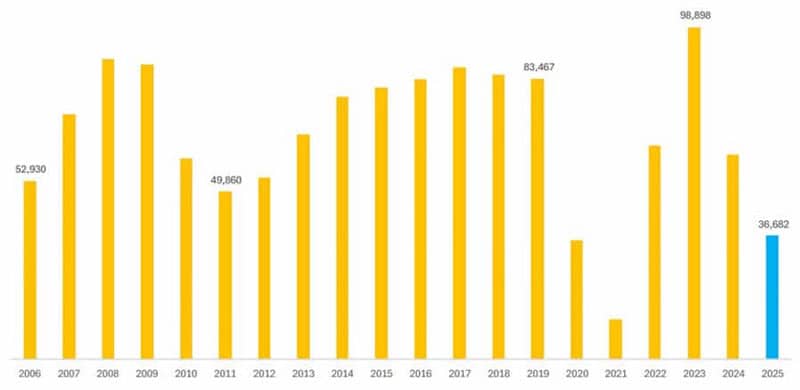
Mr Aird points out that the fee hikes are not just turning prospective students away, but they are also destroying the livelihoods of Australians working in ELICOS and economic sectors that benefit from international student spending:
“[The increases] come without care for the Australians who will lose their jobs or the Australian businesses it will destroy – and not just in the education sector. ELICOS students contribute significantly to international tourism, retail, hospitality. The damage done by past visa fee hikes has seen ELICOS numbers fall 60% to 20-year lows costing 1000s of Aussie’s their livelihoods. This new fee increase will drive that further.”
In the fall of 2023, IDP Education’s Emerging Futures survey found that in the span of just a few months, Australia had drawn even with Canada as the most preferred destination of the Big Four – largely as a result of the work opportunities it offered international students. So much has changed since then, but what hasn’t changed is that a huge part of Australia’s draw is its post-study work visa.
Writing on LinkedIn, Weihong Liang, president of the International Students Representative Council of Australia (ISRC), spoke of how current international students will be affected by the abrupt announcement of the increased cost of the Temporary Graduate visa:
“For students in their final semester, this is not an abstract policy adjustment. It is a sudden financial burden imposed at the point where they have the least room to change their plans
“Many of these students came to Australia two or three years ago. They were told that Australia welcomed international talent. Post-study work rights were widely presented as part of Australia’s international education offer. Students made major life decisions, paid substantial tuition fees, moved countries, and built their future plans around the policy settings available at the time
“Now, after they have already committed, the cost of that pathway has increased dramatically — twice in four months. At the same time, Australia continues to recruit international students globally
“Governments have the right to change migration policy. But fair policy implementation requires notice, transition arrangements, and respect for those who have already made decisions in good faith.”
Also on LinkedIn, Kaixin Ji, a PhD student specialising in human-centered AI said:
“As an international student who has studied and lived in Australia for 12 years, I feel deeply disappointed and betrayed by this country. I completed my bachelor’s and master’s degrees in IT, and I recently obtained my PhD in Computer Science. Yet after graduation, I have struggled to find a job in either industry or academia. I am also unable to apply for permanent residency because I have not had the required “skilled work” experience for skills assessment.
“This means I have to apply for the Graduate Work (485) visa — a visa that has increased twice this year and now costs A$5,750, with no prior notice … This sudden fee increase may force me to ask my parents for financial help, which feels deeply painful and humiliating as a grown adult. Australia needs to ask whether this is a fair way to treat the people it actively encouraged to come, study, work, and contribute.”
Across the sector, stakeholders have raised concerns about the government’s approach to international education. In an email to ICEF Monitor, International Education Association of Australia (IEAA) CEO Phil Honeywood said:
“Australia’s competitor study destination countries will be celebrating today at our market share’s expense. With no consultation and no phase-in period, all visa categories have been increased overnight by approximately 25% …
“The official excuse from our government [for the hikes] is that additional funds are required to pay for national security budget blowouts. However, our beleaguered sector is fed up with such excuses as we are increasingly being seen as just a cash cow for non-related budget issues.”
Felix Pirie, CEO of the Independent Tertiary Education Council Australia (ITECA), said:
“As has become the norm, this was done without sector consultation or engagement as to the likely impacts. It is difficult to build trust when surprises like this have direct and damaging effects on businesses, students, and international partners.”
Universities Australia CEO Luke Sheehy wrote about the cumulative damage of recent policies:
“For years, governments encouraged universities to build this sector because they recognised it as a national asset. The same governments that encouraged universities to build this success are now dismantling it, one decision at a time
“Today’s fee hike doesn’t stand alone. It comes on top of higher visa refusal rates, policy uncertainty and a series of decisions that have made Australia a less attractive destination
“Australia needs a stable, competitive international education policy that recognises this sector for what it is – one of our greatest national assets.”
For additional background, please see:
- “Multiple data indicators signal further declines ahead for international student numbers”
- “Australia: Multiple data indicators signal further declines ahead for international student numbers”
Most Recent
- China in 2026: Slowing outbound student mobility, accelerating inbound momentum
- Surprise hike in international student visa application fees “a direct hit to Australia’s competitiveness”
- ICEF Podcast: “Good, steady, and disciplined”: New Zealand’s plan for sustainable international enrolment growth
Most Popular
- Which countries will contribute the most to global student mobility in 2030?
- Research shows link between study abroad and poverty alleviation
- Beyond the Big Four: How demand for study abroad is shifting to destinations in Asia and Europe
Need help choosing the right university or study destination?
Start your FREE JIUniversity Admission Assessment today and discover the best international study pathway for your academic goals.
Source: monitor.icef.com
Tag:hike, International, Student, Surprise, visa

You may also like
University of Sunderland seeking £40m cuts amid visa refusals