
Deprivation points: How JNU’s unique admission model helps marginalised students
skip to content
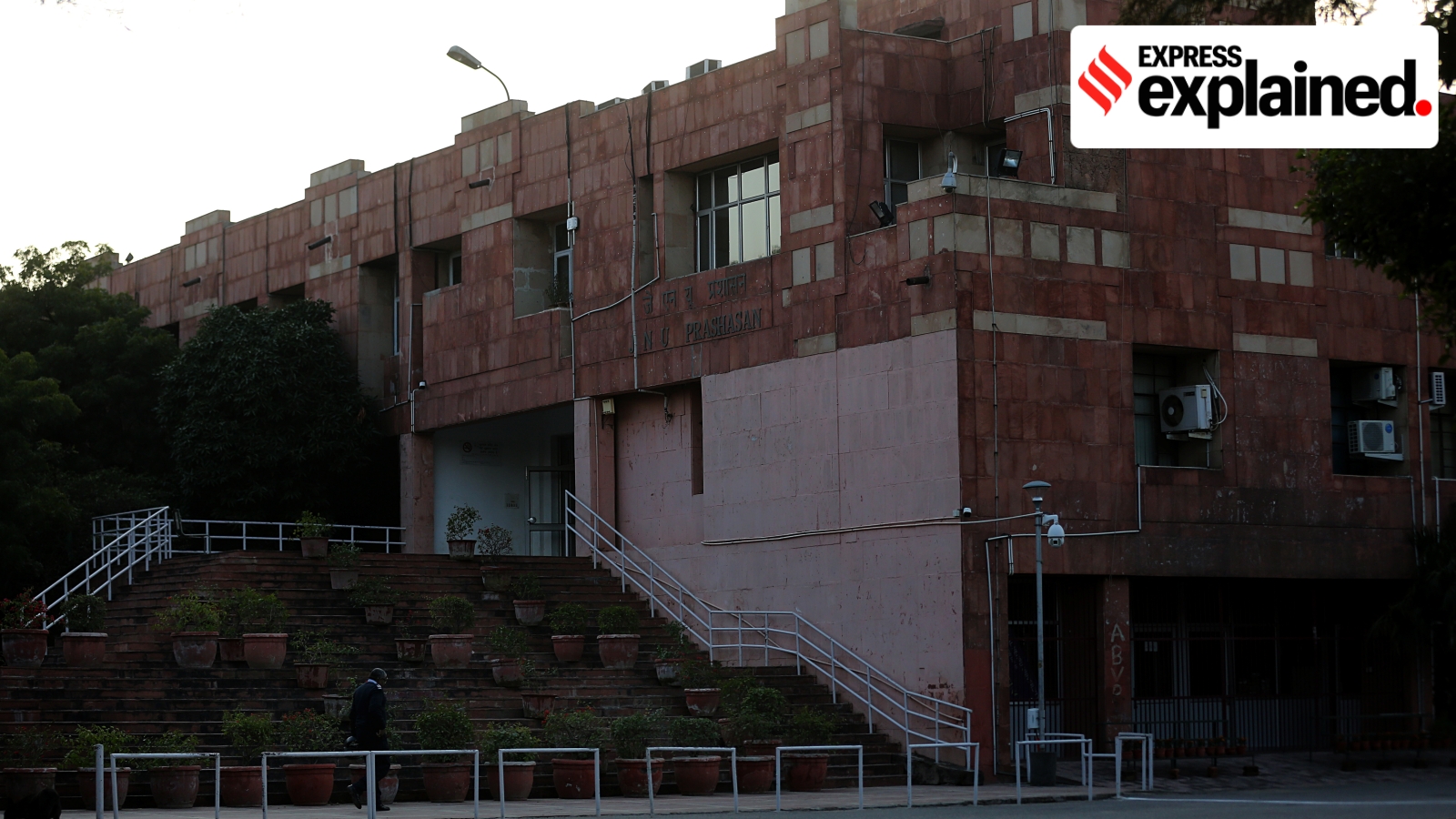
JNU introduced the deprivation points system in the 1970s. Tashi Tobgyal/file
A hallmark of Jawaharlal Nehru University’s (JNU) admissions process is its decades-old “deprivation points” model. The system, unique to the varsity, aims to give a leg up in admissions to marginalised candidates — such as those from backward regions, women and transgender persons
It has also sparked controversy from time to time since its introduction in the 1970s. In the most recent instance, an aspirant seeking admission to a JNU postgraduate course moved the Delhi High Court against the model. A division bench of the court allowed the university to continue following the system, subject to the final outcome of the candidate’s plea that’s being heard by a single judge.
What is the deprivation points model?
In the JNU admissions process, applicants to various undergraduate and postgraduate courses can be awarded a maximum of 12 points. These are known as deprivation points. The points are added to the candidate’s entrance test score before the final merit is determined
One of the factors determining the points is the district the candidate comes from. For the current admissions cycle, the university has classified districts into Quartile 1 (backward) and Quartile 2 (relatively less backward) based on four indicators using Census data — percentage of female illiteracy, percentage of agricultural workers, percentage of rural population and percentage of households with no toilet within the premises.
Candidates can receive deprivation points based on the educational levels they have completed in a Quartile 1 or Quartile 2 district. For undergraduate admissions, a candidate can receive six points for a Quartile 1 district and four points for a Quartile 2 district. For postgraduate admissions, the corresponding figures are three and two points respectively
The system also provides five deprivation points to Kashmiri migrants, subject to the required documentation
Female and transgender candidates are also eligible for deprivation points. Under the current prospectus, they receive seven points if they fall within categories including SC, ST, OBC, PwD, Quartile 1 or Quartile 2, and five points if they are from the unreserved category and do not fall in either of the two district quartiles
The points are awarded only to undergraduate, postgraduate, certificate of proficiency and advanced diploma of proficiency programmes. PhD programmes were excluded in 2017 after the varsity adopted the 2016 UGC admission guidelines. As per the regulation, a 100% weightage was to be given to viva-voce marks, without making a mention of the deprivation points system. This made the entrance test a purely qualifying test for admissions to MPhil and PhD programmes.
Why was the system put in place?
The deprivation points system was introduced to ensure that the university did not merely draw students who had already benefited from greater educational opportunities.
“When JNU was created by an Act of Parliament, it was not created for Delhi alone. It was supposed to draw talent from all across the country,” said Professor Surajit Mazumdar, Professor of Economics at JNU’s Centre for Economic Studies and Planning and President of the JNU Teachers’ Association
According to Mazumdar, the idea was that academic performance alone could not be treated as a complete measure of merit when students came from vastly different social, economic and regional circumstances. The model has helped address forms of disadvantage that reservation alone could not capture, he said
In its initial form, districts were grouped according to objective indicators of development, with students from more deprived regions receiving additional weightage. The system was meant to “equalise” the conditions under which students competed for admission
The deprivation points system was withdrawn in 1984, but was restored from the 1995-96 academic year after pressure from the students’ union
Why does the model matter?
The adoption of affirmative action policies in higher education institutions in India had been minuscule until the implementation of 93th Constitutional Amendment in 2005 which formally enabled reservation for SC, ST and other backward sections in Central Universities.
Around one-third of the world’s countries utilise affirmative action or targeted quotas — including those based on geographic or development indicators — to improve educational access, said the 2026 UNESCO Global Education Monitoring Report. It said India, alongside Brazil, China, Israel and Sri Lanka, had seen “increased enrolment among under-represented groups” due to targeted measures.
JNU’s system is unique to any institute in the country, said Rituparna Patgiri, Assistant Professor of Humanities and Social Sciences at Indian Institute of Technology-Guwahati.
“I think the fundamental innovation that JNU tried to achieve through the deprivation points is not about which social category one belongs to, but the kind of structural deprivation and inequalities which shape the educational opportunities available to the person. So it recognised the disadvantage associated with educational attainments in districts, especially considering India’s diverse regional geography,” said Patgiri. “Our understanding of merit becomes more complicated when we consider how geography and region impact socio-historical marginalisation.”
Mazumdar said: “If the standard indicator of performance is academics alone, then it does not serve inclusivity. There are different kinds of disadvantages, and there should be something to compensate for them — gender-based, caste-based, region-based. The idea was to level up the contest so that merit itself becomes the outcome. This is upholding the principles of equality, not violating them.”
The model has brought students from diverse socio-economic and regional backgrounds, and proved through their performance that people from different backgrounds could come here and excel, he said
“The system has given JNU a unique character. Its achievement has been that nobody could say this was a university where academic excellence came at the cost of equality. There was a synergy between academic excellence and the principles of equality.”
© The Indian Express Pvt Ltd
- India vs Netherlands Live Score, Hockey World Cup 2026: NED thrash IND 3-1, leaves them on the brink of elimination17 minutes ago
- World News Today Live Updates: 2 US tanker aircraft leave Bulgaria a month after deployment upset Iran31 minutes ago
- Sowcar Janaki (1931-2026): Vijay, Kamal Haasan, Chiranjeevi, Jr NTR pay tribute to actor1 day ago
- India news 21 August Live Updates: Crane collapses in Mumbai’s Kurla, 10 injured1 day ago
- World News Updates: Gold mine landslide kills at least 100 in Central African Republic2 days ago
Need help choosing the right university or study destination?
Start your FREE JIUniversity Admission Assessment today and discover the best <a href="https://jiuniversity.com/vietnam-to-award-1500-full-scholarships-for-strategic-technology-training-abroad-vnexpress-international/” title=”Vietnam to award 1,500 full scholarships for strategic technology training abroad – VnExpress International”>international study pathway for your academic goals.
Source: indianexpress.com
Tag:admission, Deprivation, JNUs, points, unique