
Study: European Wildfires Could Triple by 2100
Europe’s burned area could nearly double by the end of the century compared with today, according to a study published on August 20 by the Potsdam Institute for Climate Impact Research, with the Senckenberg Society for Nature Research as a partner. The paper appeared in the journal Global Change Biology under identifier 10.1111/gcb.71043, with Mike Billing, a researcher at the Potsdam Institute, as lead author.
The team compared the projected annual average for 2070 to 2100 against a modeled reference period of 2000 to 2030. Under the low emissions scenario, labeled SSP1-2.6, burned area rises by about 39 percent a year. Under the high emissions scenario, labeled SSP3-7.0, the increase reaches about 192 percent. The authors single out the Mediterranean, Western Europe and Central Europe as the regions where fire conditions worsen the most.
“Climate change is driving fire activity across Europe as hot, dry and windy conditions become more severe,” Billing said in a statement from the institute
“Our results show that a widespread increase in burned area could occur even under comparatively low warming of around 1.8 degrees Celsius,” Billing added
The second part of the paper, developed by co-authors from Senckenberg, models how much human intervention, prevention, early detection and firefighting can offset that growth in a warmer world. By that calculation, better fire management could cut burned area by 92 percent at 1.8 degrees Celsius of warming. At around 3.6 degrees, that reduction drops to 72 percent, meaning the hotter it gets, the less firefighting can make up for it.
Thomas Hickler, a scientist at the Senckenberg Society for Nature Research and co-author of the study, warns that this capacity is not unlimited
“We see that fire conditions are worsening, so we need to invest more, but if fires become truly extreme, our ability to contain them could break down,” Hickler said in the institute’s statement
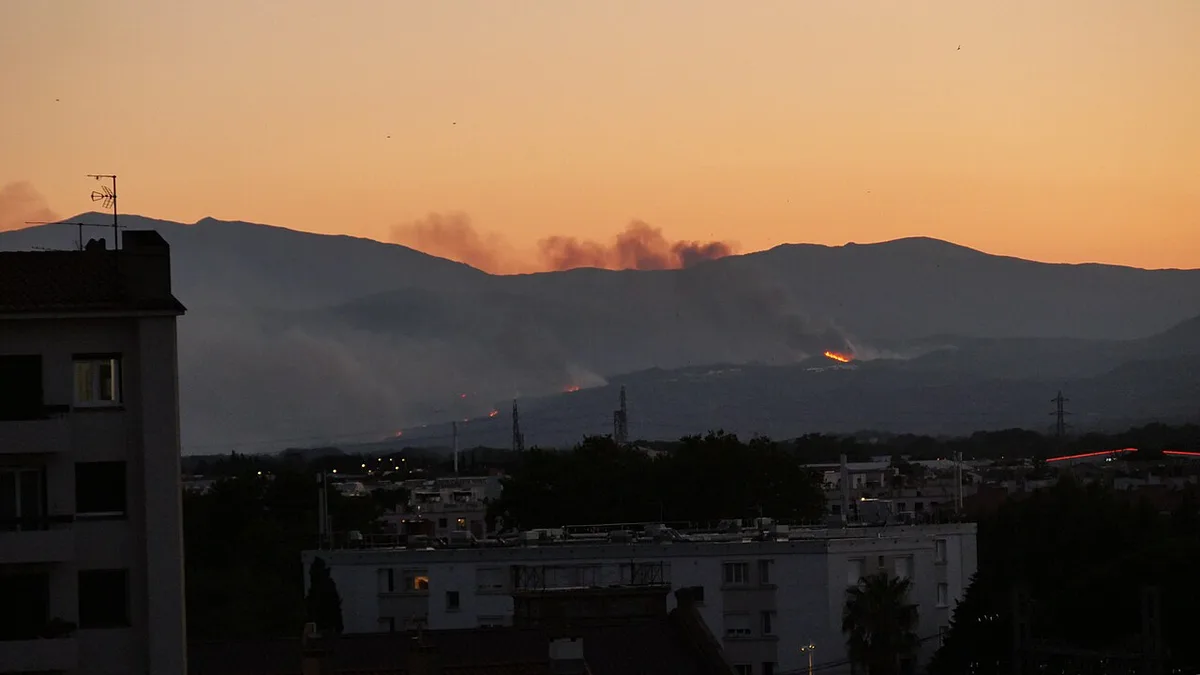
The study was published in the middle of another difficult wildfire season in Europe. By August 12, 2026, about 550,000 hectares had burned in the European Union, roughly 2.5 times the twenty-year average for that date. As examples from this season, the authors point to the wildfires in France, Spain and Greece
“The wildfires in France, Spain and Greece show how quickly hot, dry and windy weather can stretch firefighters and their reute and co-author of the study
Thonicke adds that cutting emissions remains an unavoidable part of the response, no matter how much is invested in firefighting. “With climate change, conditions could become so extreme that we truly reach the limits of what we can do to prevent and put out fires once they reach a certain size. That is why cutting emissions is absolutely essential, together with strengthening local fire management,” Thonicke concluded.
The paper does not claim that this growth in burned area will certainly happen, nor that the specific wildfires this season in France, Spain and Greece are a direct result of the calculated scenarios. They are offered only as context alongside which the study was published. It is a projection of two climate scenarios at the end of the century, not a measurement of what caused any single fire. The authors themselves caution that the estimate of how much firefighting can help in a much hotter world may prove more optimistic than reality allows, since it is based on the fire management capabilities we have today.
Podeli
OceniKomentari…
Next story
Need help choosing the right university or study destination?
Start your FREE JIUniversity Admission Assessment today and discover the best international study pathway for your academic goals.
Source: srpske.rs

You may also like

European higher education week opens new opportunities