
UK: August’s sponsored study visa applications drop to lowest level since 2022
Short on time? Here are the highlights:
- Between January and August 2026, far fewer international students applied for a visa to study in the UK than in previous years
- Especially if the current pattern persists, the combination of lower applications, high visa rejection rates, and thousands of visa application withdrawals could have a substantial impact on UK universities’ foreign enrolments in 2026/27 and after
Newly released UK Home Office data shows that sponsored student visa application volumes are down significantly through August of this year
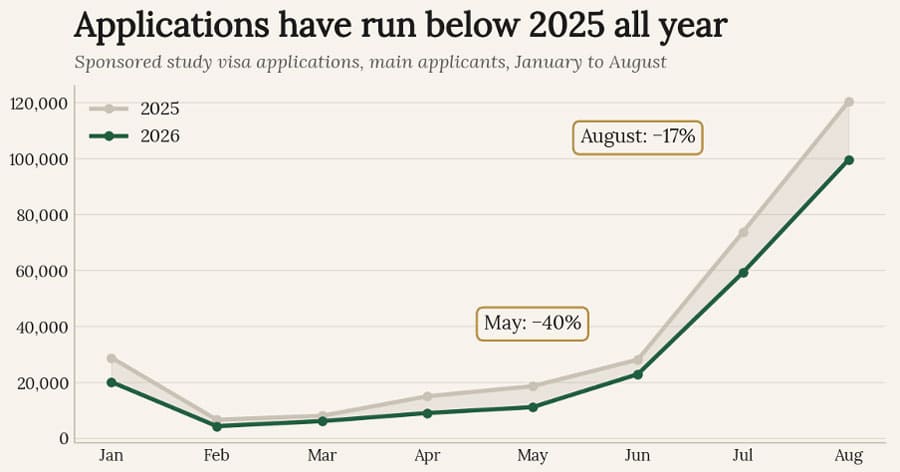
August is a particularly important month in the application cycle because it represents such a large share of all applications lodged throughout the year – at least a quarter of the total. More broadly, the summer months plus September comprise about 70% of all applications. This year, applications fell by -17% in August and by -18% across June, July, and August
These declines are even worse than last summer, when the Dependants Ban deterred many “main” (i.e., student) applicants because they could no longer bring their families. About 99,500 main applicants applied in August 2026 – 20,800 fewer than in August 2025, and the lowest count since tracking began in 2022. The following chart, created by Spencer Withrington for a recent article in his market intelligence newsletter, Admit, shows that the downward trend has characterised all months of 2026 so far.
The Dependants Ban means that the Home Office will only process applications from a family member of a student if that student is in a research master’s or PhD programme. This has resulted in a cumulative drop of -88% in dependant applications between December 2023 (the last month before the rule took effect) and August 2026. Dependants can only apply when their submission is attached to that of the student they hope to accompany, which means that the fall in dependants’ applications is also a factor in lower applications from students themselves.
Looking for a moment at spring 2026 trends, 31,222 sponsored study visas were granted in Q2 2026, a -43% drop in issuances compared with Q2 2025. While fewer applications were most of that story, a high visa refusal rate of about 8% in that quarter was also influential. Visa rejection rates are variable through the year, and the rate in the second half may prove to be lower than the first half. Still, Q2 trends alone remind us that of the low number of applications received the summer months of 2026 (181,500), several thousand will likely be refused.
Q2 2026 visa data show that refusal rates were especially high for key sending markets including India, Nigeria, Bangladesh, and Ghana, and that visa grants were very low for India, Nepal, Nigeria (down by least -50% compared with Q2 2025) and especially Pakistan (-90%)
In 2025, it was primarily the Dependants Ban that depressed sponsored study visa applications. This factor is still in play, but it is now joined by a host of other ones
One of these is the UK’s Basic Compliance Assessment (BCA) framework and its accompanying Red-Amber-Green (RAG) banding system. As of 1 June 2026, the RAG system obliges UK institutions to maintain a visa refusal rate of less than 5%. Universities whose refusal rates reach above that benchmark can be subject to sanctions or even to the suspension of their license to sponsor international students. This is causing many institutions to apply much greater scrutiny to student applicants. Some are taking it a step further and limiting or pausing recruitment in markets where visa rejections are high.
Pakistan is a good example of the combined effect of high visa refusal rates and the RAG system on applications. Pakistani students don’t want a rejection on their record, and they know they are increasingly likely to receive one if they apply. They are also seeing some UK universities lose confidence in recruiting in their country due to the RAG system. At the same time, Pakistani students are aware of a growing list of compelling alternative destinations.
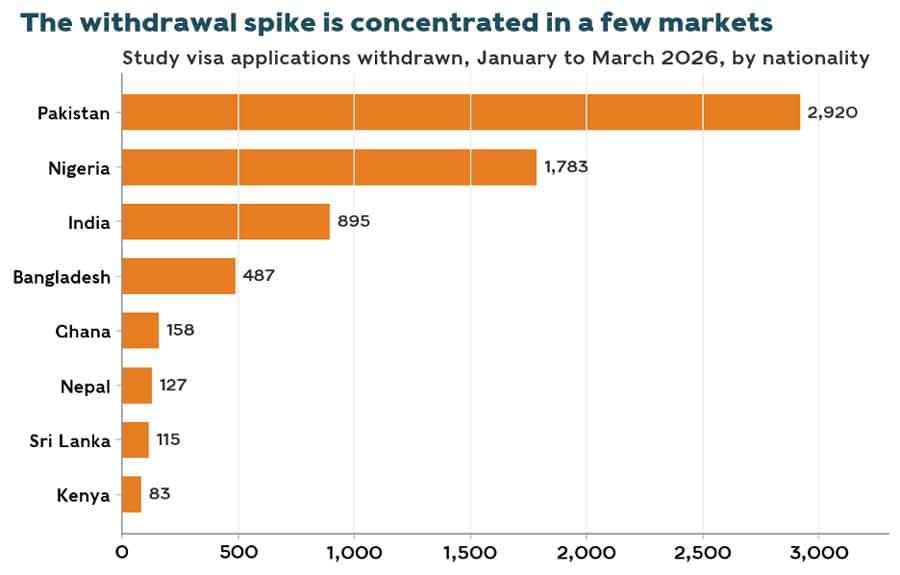
Again, we can use Pakistan to illustrate another trend that will affect enrolments in UK universities in 2026 and 2027. As a sending market, Pakistan held up remarkably well after the Dependants Ban, with +13% more Pakistani main applications in 2024 despite an -85% drop in Pakistani dependant applications. But now that Pakistan is more affected by the RAG, visa decision delays, and high rejection rates than many other sending markets, the patience of the market is being tested. In late-2025, only a few hundred Pakistani students withdrew their sponsored study visa applications. In Q1 2026, nearly 3,000 did.
Pakistan is the most striking example of a rising withdrawal rate, but it is not the only one. In Q4 2025, the total number of withdrawals (from all sending markets) was under 2,000. In Q1 2026, withdrawals more than tripled to about 7,000
In the conclusion to Admit’s Issue 021 newsletter, Mr Withrington leaves university leaders with a few questions they might ask themselves about two key markets as a result of low applications and more visa rejections in the first three quarters of 2026:
- “Do you know your own refusal count for Nigeria for the September 2026 intake? Enroly’s rate is 12% and the Home Office’s for April to June was 25%. If yours is anywhere near either, ask whether one market is enough on its own to carry you over the 5% line.
- What happens to your recruitment plan if Chinese demand falls by a fifth, the fall the Home Office table shows for the summer as a whole? On Day 28 China supplied more than all of the sector’s growth in undergraduate international acceptances.”
In June 2026, Professor Malcolm Press, president of Universities UK, was quoted in a government release announcing the RAG system. Mr Press said the sector committed to partnering with the government on integrity concerns, but he warned:
“What universities need from government is policy stability, transparent visa decision-making, and real-time data to act on emerging concerns. The sector relies on international student income, and recent sharp declines have led to substantial cost-cutting and job losses. It is essential that we build a fair, stable, and transparent system that works in the national interest …. International students bring significant economic and soft power benefits, contributing £37 billion in export earnings.”
For additional background, please see:
- “UK: Visa application withdrawals surpass refusals in Q1 2026”
- “UK: Sponsored study visa issuances down, rejection rates up, and more”
- “Narrowing bands of compliance: How the UK’s new RAG system will impact international student recruitment”
Most Recent
- Australia moves to reduce net migration with new restrictions on student family members and “visa hopping”
- How can we tell the story of international education?
- UK: August’s sponsored study visa applications drop to lowest level since 2022
Most Popular
- Which countries will contribute the most to global student mobility in 2030?
- Research shows link between study abroad and poverty alleviation
- Beyond the Big Four: How demand for study abroad is shifting to destinations in Asia and Europe
Need help choosing the right university or study destination?
Start your FREE JIUniversity Admission Assessment today and discover the best international study pathway for your academic goals.
Source: monitor.icef.com
Tag:Applications, Augusts, sponsored, study, visa