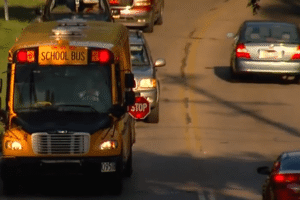
Texas school bus funding falls short as districts face route cuts and rising transportation costs
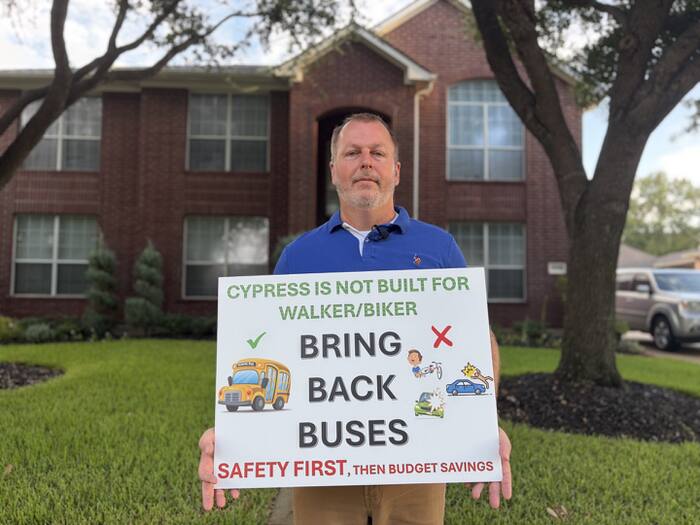
SPRING, Texas – Jarred Hostetler never got rid of the posters he made in 2024 to protest his kids’ school district’s decision to eliminate almost 80 school bus routes. Cypress-Fairbanks Independent School District cut the transportation budget that year to lower the district’s multi-million-dollar budget shortfall
After multiple protests and 33 auto-pedestrian crashes, the district restored the eliminated stops. Cy-Fair ISD now provides transportation for any student attending their zoned campus. The change resulted in fewer students being hit while walking to school, according to CyFair ISD’s data
Recommended Videos
But just two years later, families are at risk of losing them again
“Ever since we got the bus cut, I have been watching the school board very closely. I realized they are drawing from their savings to keep paying for the bus every year,” Hostetler said. “Eventually that money was going to run out.”
CyFair Superintendent Dr. Doug Killian said in a board meeting in Augustthe transportation budget would be the first to be cut if voters did not approve the tax rate increase the district placed on the November ballot
“That is where we are the biggest off in the entire state,” Killian said about its nearly $60 million transportation budget
Budget data shows school districts across Texas are spending substantially more on transportation than they receive from the state. Records show state funds only covered 15 percent of Cypress-Fairbanks’ transportation costs last year
Budget records analyzed by KPRC’s Enough team show this year the state covered roughly 13 percent of Alief ISD’s transportation costs – and the state reimbursed Fort Bend ISD $6.6 million to go towards the nearly $33 million the district projects it will spend this school year
Texas funds local school transportation partially. The state reimburses districts $1 for every mile a general education student travels on a bus. It also requires the state to give school districts up to $1.13 for every mile a special education student travels. When Texas lawmakers passed a bill in 2025 that pumped billions into public schools, the new law gave districts 5 cents more for every special education mile it ran. It amounted to $160,000 more for CyFair ISD.
Districts can seek additional state funding for kids who live within 2 miles of their school and would otherwise have to walk a hazardous or high-risk route. But there is a cap on how much each district can get reimbursed – and it’s up to each district to determine what qualifies as hazardous
“In school districts like ours, we transport so many kids. We cover such a large area. To get as many kids as we can to school safely and efficiently – we need more money,” Conroe ISD Transportation Director Juan Melendez said
Melendez’s district transports more than 33,000 students and covers 348 square miles near Houston. The district guarantees a bus ride to students who live 1 mile or more away from their assigned school, which means it’s covering more than the state will help pay for
“I don’t want to say we are overworking our workforce, but we are pushing them,” Melendez said
Austin Independent School District moved to a centralized bus hub system earlier this school year as a part of cost-cutting measures to lower its multi-million-dollar budget deficit. The district ended the system and restored neighborhood stops, except for high schoolers, after parents expressed outrage over the change
Houston Independent School District switched to a similar centralized bus system for its 27,000 magnet students this year to address the district’s budget shortfall. The program has frustrated parents struggling to get their students to new bus stops that can be miles away from their homes
Even for families who have not had their bus route cut altogether, some still report barriers to getting their kids to school. Adriana Sandoval said last school year, the bus stopped feet from her home in Conroe to pick her 9-year-old up for school
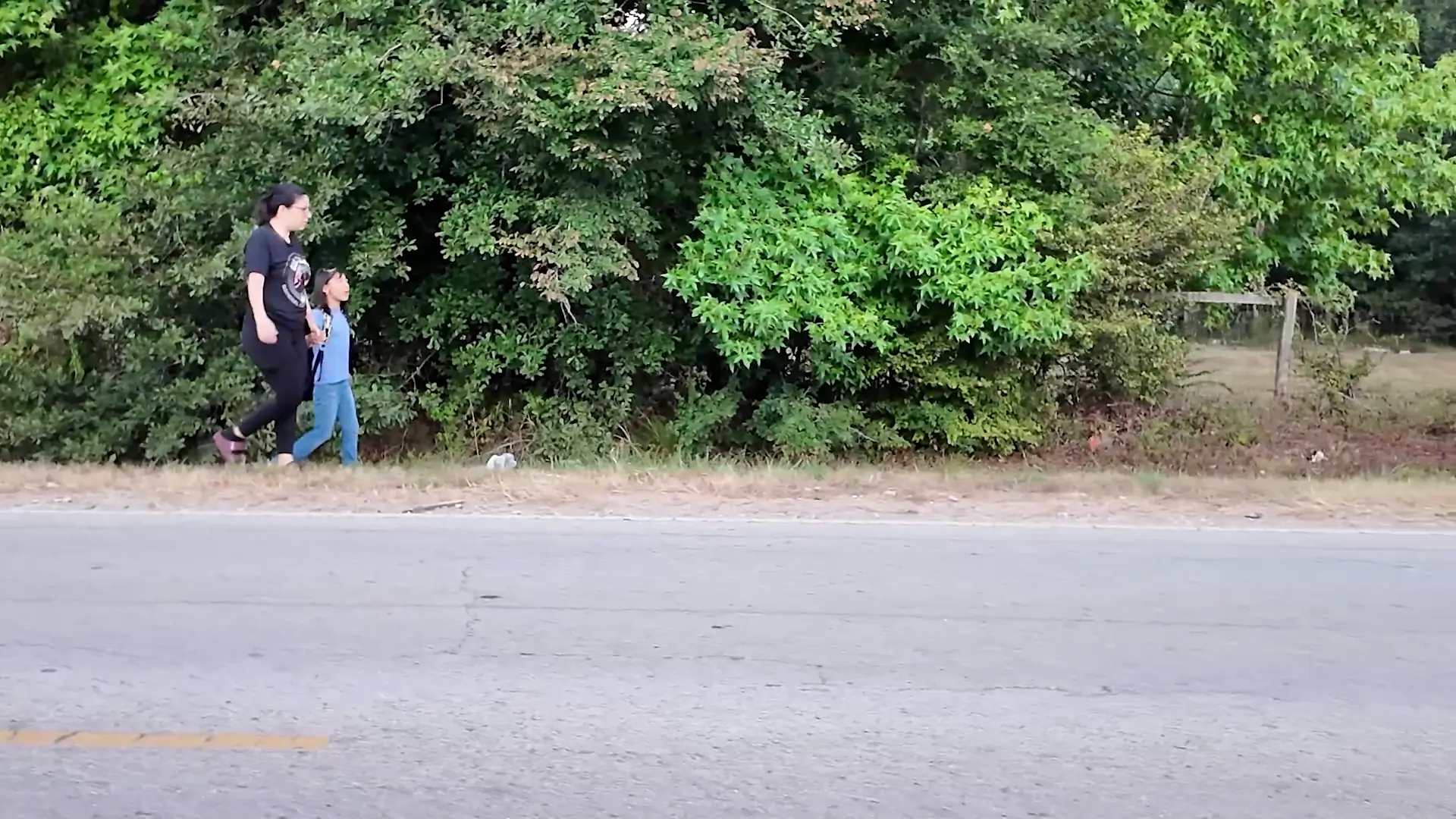
Sandoval said the problem this year was not the walk to the bus stop, which is less than a mile from their home, but the hazards along the way. To reach it, her fourth-grade daughter would have to walk beside a washed-out stretch of Crockett Martin Road with no sidewalks
In the morning, Sandoval drives her daughter to school on her way to work. It’s the afternoon when she can’t leave work that says leaves her panicked
“Around 3:40, when I get her bus notification, I am worried and constantly calling until she gets inside and then I am like I can go back to focusing on work,” Sandoval said
Melendez said his transportation department handles complaints from parents about hazardous routes to school – and even to the bus stop on a case-by-case basis. He said the district typically does an in-person stop assessment to see if the location meets the hazardous routes criteria. But Melendez said those stop assessments are more difficult to do at the beginning of the year when the transportation department is busier.
Each school district is responsible for defining hazardous bus routes, but state law provides some guidance on local policy. The state statute defines a hazardous route as “an area […] where no walkway is provided and children must walk along or cross a freeway or expressway, an underpass, an overpass or a bridge, an uncontrolled major traffic artery, an industrial or commercial area, or another comparable condition.” The statute also describes an area with a “high risk of violence” as an area “that law enforcement records indicate presents a high incidence of violent crimes.”
Melendez described a situation this year in which Conroe ISD’s routing system automatically assigned a student to the “closest stop.”
“What we found out is that the kid was having to cross a street that he shouldn’t be crossing,” Melendez said. “We immediately identified it and then found a stop within the neighborhood where the kid did not have to cross that street and made the change within 24 hours.”
Melendez also said sometimes the bus operators he supervises will alert the transportation department the road is changed or construction is happening along bus routes. “We rely on them. We have a routing team. We have a safety team that looks at it. It’s ongoing process throughout the year,” Melendez said
Three weeks after Sandoval showed us her daughter’s route to the bus stop, she provided an update: The stop remained unchanged, but her daughter’s bus driver from the previous year had begun picking up the 9-year-old each day
“My daughter told her the situation, and she said I don’t want you walking that route either,” Sandoval said. “I got lucky that she remembered her and was nice enough to drop us off at the house.”
Texas State Sen. Carol Alvarado, D-Houston, said she believes transportation funding will be more of a priority this year because of school closures across the state. Families, in her words, are traveling longer distances. Districts are also navigating how to fund stricter state requirements for buses with seatbelts
“Parents having to get to work. They are relying on that transportation,” Sen. Alvarado said. “We know that a lot of the schools have very old buses that need to be replaced, so there needs to be some stream of funding for that.”
Copyright 2026 by KPRC Click2Houston – All rights reserved
Need help choosing the right university or study destination?
Start your FREE JIUniversity Admission Assessment today and discover the best international study pathway for your academic goals.
Source: www.click2houston.com