UK visa rules cause decline in foreign students from India, Pakistan, Bangladesh and Nigeria
skip to content
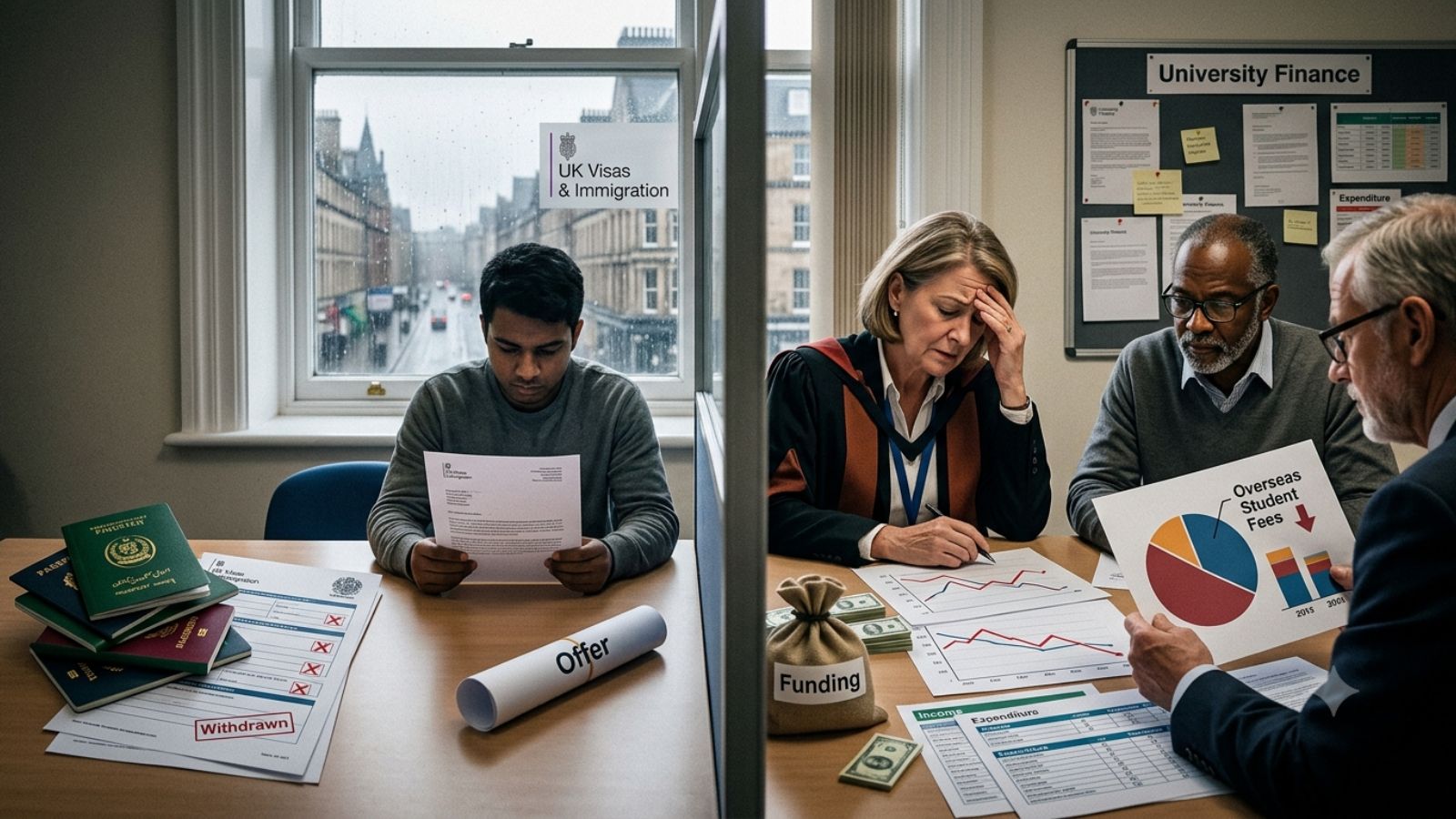
The change has left universities balancing international recruitment against the risk of losing their ability to sponsor overseas students (AI Image)
The United Kingdom is seeing a sharp rise in withdrawn student visa applications from Pakistan, Nigeria, Bangladesh and India, as universities pull back from recruiting international students amid tighter immigration rules. In the first half of 2026, 10.5 per cent of study visa applications were withdrawn, compared with 2.3 per cent in the same period in 2025 and 0.4 per cent in 2023. The increase has been particularly steep for Pakistani applicants, with more than two in five applications withdrawn.
Based on Home Office data, aFinancial Timesreport finds that universities are increasingly revoking offers to overseas applicants to avoid breaching a stricter visa compliance threshold. Institutions that see more than 5 per cent of prospective international students with offers subsequently refused a visa now risk losing the right to recruit international students, down from the earlier threshold of 10 per cent. The change has prompted universities to reconsider recruitment from countries where visa refusals have risen, raising concerns about the impact on students, higher education institutions and the wider British economy.
Why are UK universities withdrawing offers?
The withdrawal figures underline the scale of the change. Between January and June 2026, 40.9 per cent of study visa applications from Pakistan were withdrawn, up from 3 per cent in the corresponding period last year. The proportion rose from 4.5 per cent to 22.7 per cent for Nigerian applicants, from 7.1 per cent to 23.5 per cent for Bangladeshi applicants, and from 1.2 per cent to 5.2 per cent for Indian applicants.
Read | UK Universities crisis: Job cuts, strikes and course closures put arts, humanities under pressure
A withdrawal does not necessarily mean that the Home Office has rejected a visa application. International students can apply for a study visa only after receiving an offer from a university. If an institution subsequently revokes that offer, the associated visa application is withdrawn.
Universities told the FT that the rise in withdrawals has largely been driven by institutions pre-emptively cancelling offers to “protect their compliance records.”
UK student visa application withdrawal rates by nationality
| Country | Jan–June 2025 | Jan–June 2026 | Change |
| Pakistan | 3.0% | 40.9% | +37.9 percentage points |
| Nigeria | 4.5% | 22.7% | +18.2 percentage points |
| Bangladesh | 7.1% | 23.5% | +16.4 percentage points |
| India | 1.2% | 5.2% | +4.0 percentage points |
| All applicants | 2.3% | 10.5% | +8.2 percentage points |
The move follows a doubling in study visa refusals by the Home Office in the first half of 2026 compared with the same period in 2025. The government has tightened the rules governing universities that sponsor international students, with particular scrutiny of nationalities it suspects may be using the student route to enter the UK and subsequently claim asylum
Also Read | UK eases immigration for Erasmus+ visitors from October 8: What changes for Indian students
The change has left universities balancing international recruitment against the risk of losing their ability to sponsor overseas students. Around 15 universities are reported to have suspended recruitment from Pakistan altogether this year, while institutions have also stopped recruiting from other markets to keep their refusal rates below the new threshold
Also Read | UK student visa applications fall 16% as August total drops below 100,000
Universities have questioned the consistency of visa decisions. The FT reported cases in which applicants were refused because they had previously considered studying in another country, or because a PhD applicant could not name course modules that did not exist for the research degree. University of East Anglia officials also cited a case in which an applicant was rejected after an interviewer appeared not to understand where the university was located.
Jamie Arrowsmith, director of Universities UK International, said visa processing had become “markedly less predictable.” University leaders have argued that inconsistent decisions are forcing institutions to withdraw offers on a large scale, even when applicants have already secured admission
How does this affect the UK’s international student numbers?
Home Office figures cited by the FT report show that applications from main student visa applicants fell 16 per cent to 360,700 in the year ending August 2026. Applications from student dependants declined 22 per cent to 17,000. Together, the two categories accounted for 377,700 applications, down from 449,800 in the previous 12-month period
Also Read | Indians largest group in UK study and graduate visas, surpasses China
The fall follows a series of immigration policy changes that have affected the UK’s appeal to international students. Since January 2024, most international students have been unable to bring dependants unless they meet specific exceptions, including certain postgraduate research students. The number of dependant applications in the year ending August 2026 was 88 per cent lower than in the year ending December 2023, before the restrictions took effect.
Indian students remain an important part of the UK’s international education market. They received 82,523 sponsored study visas in the year ending June 2026, making them the second-largest nationality group after Chinese students, who received 86,368. However, grants to Indian students fell 16 per cent year on year
Why could the crackdown hurt the UK economy?
International student fees are an important ions face rising costs and pressure on other ld therefore have consequences beyond admissions, affecting university budgets, employment and the range of courses institutions can sustain
University Alliance chief executive Vanessa Wilson warned that the financial impact could lead to restructurings, job losses and course and campus closures. James Miller, vice-chancellor of the University of the West of Scotland and convener of Universities Scotland, said some universities could see overseas student numbers fall by more than 20 per cent this year, making job cuts difficult to avoid if the situation continued.
The economic stakes extend beyond university fee income. International students spend money on accommodation, transport, food and other services while studying in the UK. Their presence also supports employment in universities and the surrounding economy. A sustained decline in enrolments could therefore affect local businesses and communities that depend partly on student spending
© IE Online Media Services Pvt Ltd
- US-Iran War Live News Updates: Trump says those leaking details of US strikes on Iran ‘should be shot dead’3 hours ago
- Jailer 2 Movie Review Live Updates: Kamal Haasan reacts as Rajinikanth film gets positive reviews, eyes Rs 200 cr3 hours ago
- Board Exams 2027 Live Updates: Check Madhya Pradesh 10th, 12th board exam dates7 hours ago
- In SC/ST case, Supreme Court protects woman journalist who accused ACP of sexual harassment9 hours ago
- Supreme Court issues notice in plea against immunity to CEC, ECs, to hear cases Thursday16 hours ago
Need help choosing the right university or study destination?
Start your FREE JIUniversity Admission Assessment today and discover the best international study pathway for your academic goals.
Source: indianexpress.com

You may also like

The Decline of Student Visas and Its Implications