
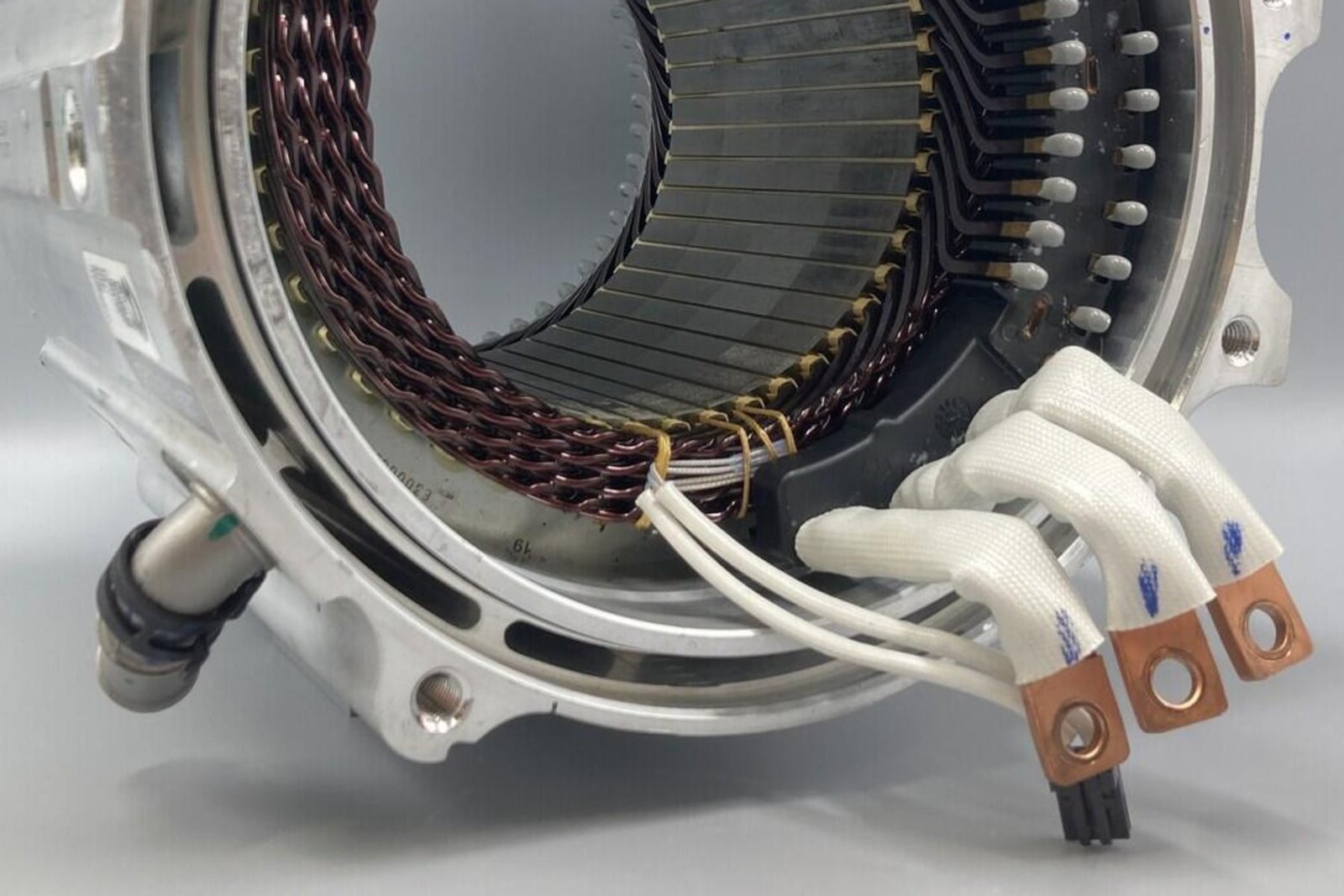
German study compares electric motors from China, Europe and the USA – electrive.com
Researchers at Germany’s renown RWTH Aachen <a href="https://jiuniversity.com/msu-remains-top-10-us-public-university-for-employability/” title=”MSU remains top 10 US public university for employability”>University examined 115 electric motors from 80 electric vehicles. They found that drivetrains from China, Europe, and the USA differ little in their basic design but vary in materials and individual construction details
For the study now published in the specialist journal Energies, the Chair of Production Engineering of E-Mobility Components (PEM) at RWTH Aachen University examined electric motors from vehicles from model years 2019 to 2025. As its title suggests, the study, titled Review and Benchmarking of Electric Motor Product Design and Manufacturing Technologies from the Chinese Market, focused on the Chinese market and was supplemented by comparative data on European and US drivetrains.
The researchers conclude that electric drivetrains from the three markets differ little in their fundamental architecture. This applies, among other things, to housing structures, rotor and stator geometries, and the cooling concepts of newer models. The most pronounced differences were found in materials and individual components
For example, Chinese manufacturers increasingly use magnesium alloys for housings, while European manufacturers more frequently opt for aluminium. The study also identifies differences in power distribution busbars. Whereas Chinese manufacturers predominantly use powder-coated busbar solutions, European manufacturers tend to employ more complex assemblies in which multiple copper bars are embedded in a polymer component.
Across markets, the study shows a clear trend toward more compact and highly integrated drivetrain units. Since 2022, highly integrated concepts — where the motor, transmission and power electronics are more closely combined — have dominated the examined sample
At the same time, evidence shows a significant increase in the average peak power density of permanent magnet synchronous motors, which rose from 1.68 kW/kg in 2019 to an average of 2.43 kW/kg for models from 2024 and 2025—an increase of nearly 45 per cent
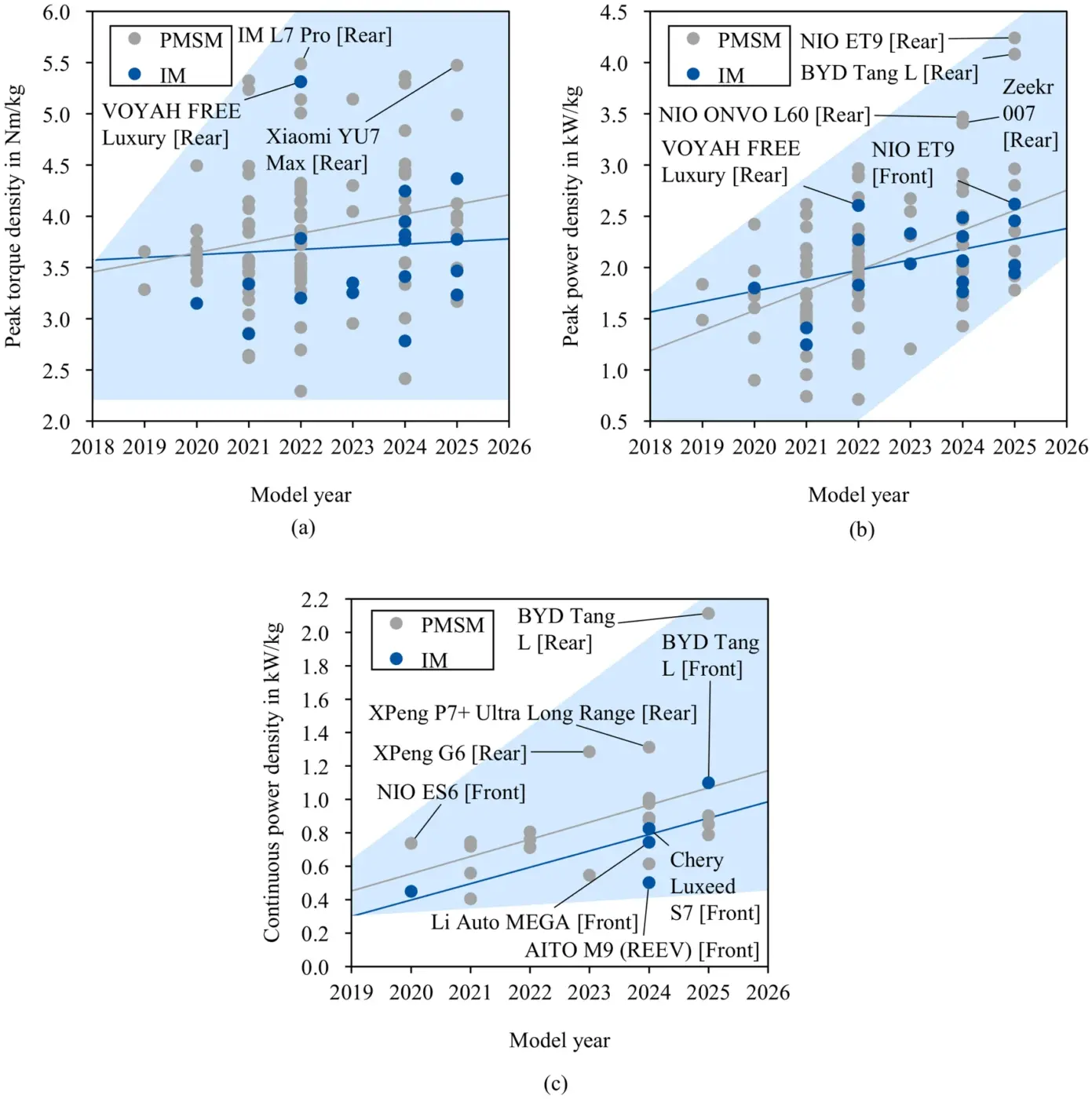
Power density of electric motors over time.
A key factor in this development is higher rotational speeds. While maximum motor speeds between 2020 and 2022 were predominantly in the range of 8,000 to 17,000 rpm, newer drivetrains increasingly operate at 20,000 rpm or higher. Some motors even reach up to 30,500 rpm, according to the study. In parallel, the average gear ratio increased by around 21.5 per cent over the period examined
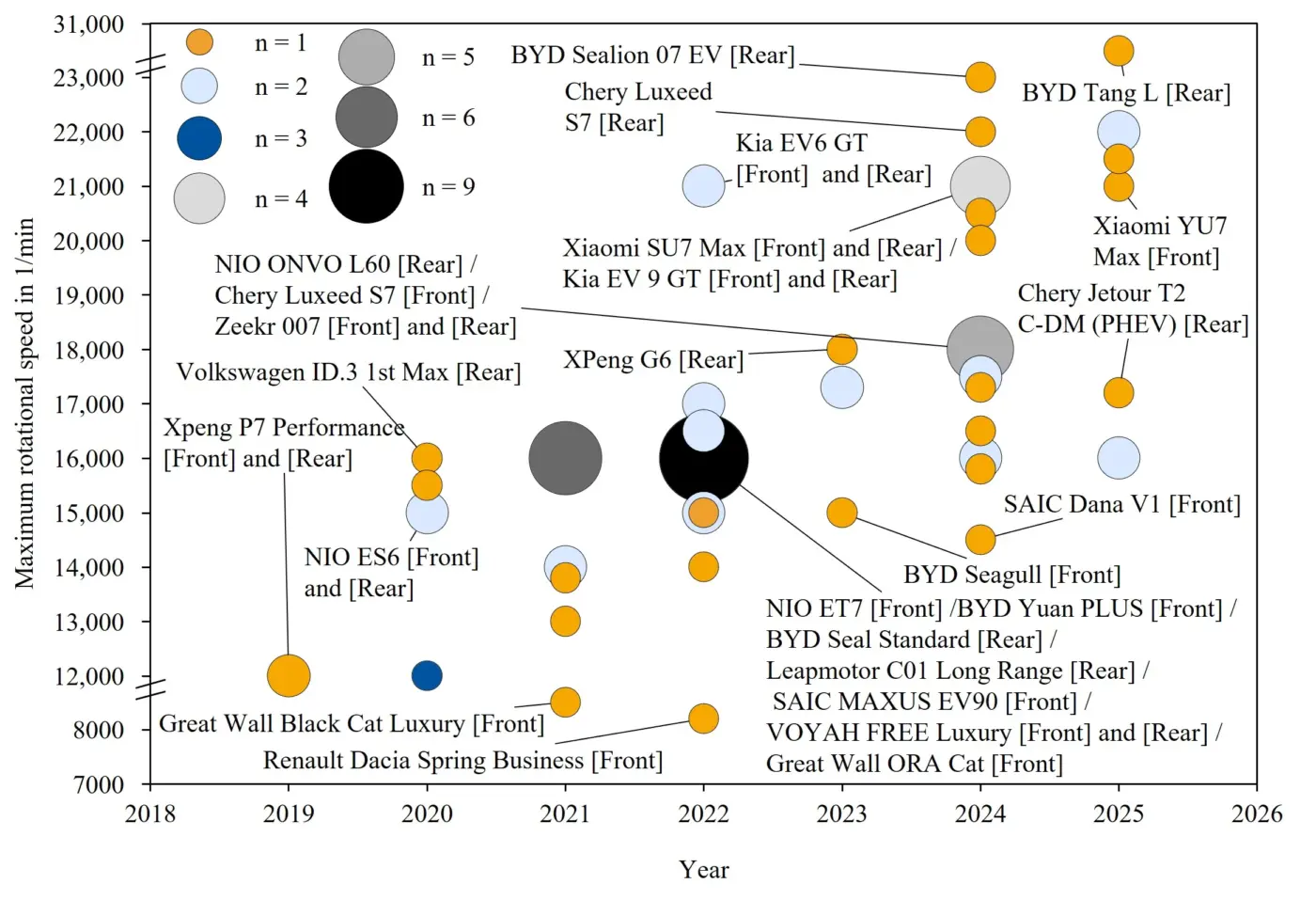
Maximum motor speeds are rising significantly.
Higher rotational speeds enable smaller rotor and stator diameters, reducing material usage. However, the study points out that higher speeds do not automatically lead to more compact motors. In some cases, they are also used to increase the possible vehicle speed
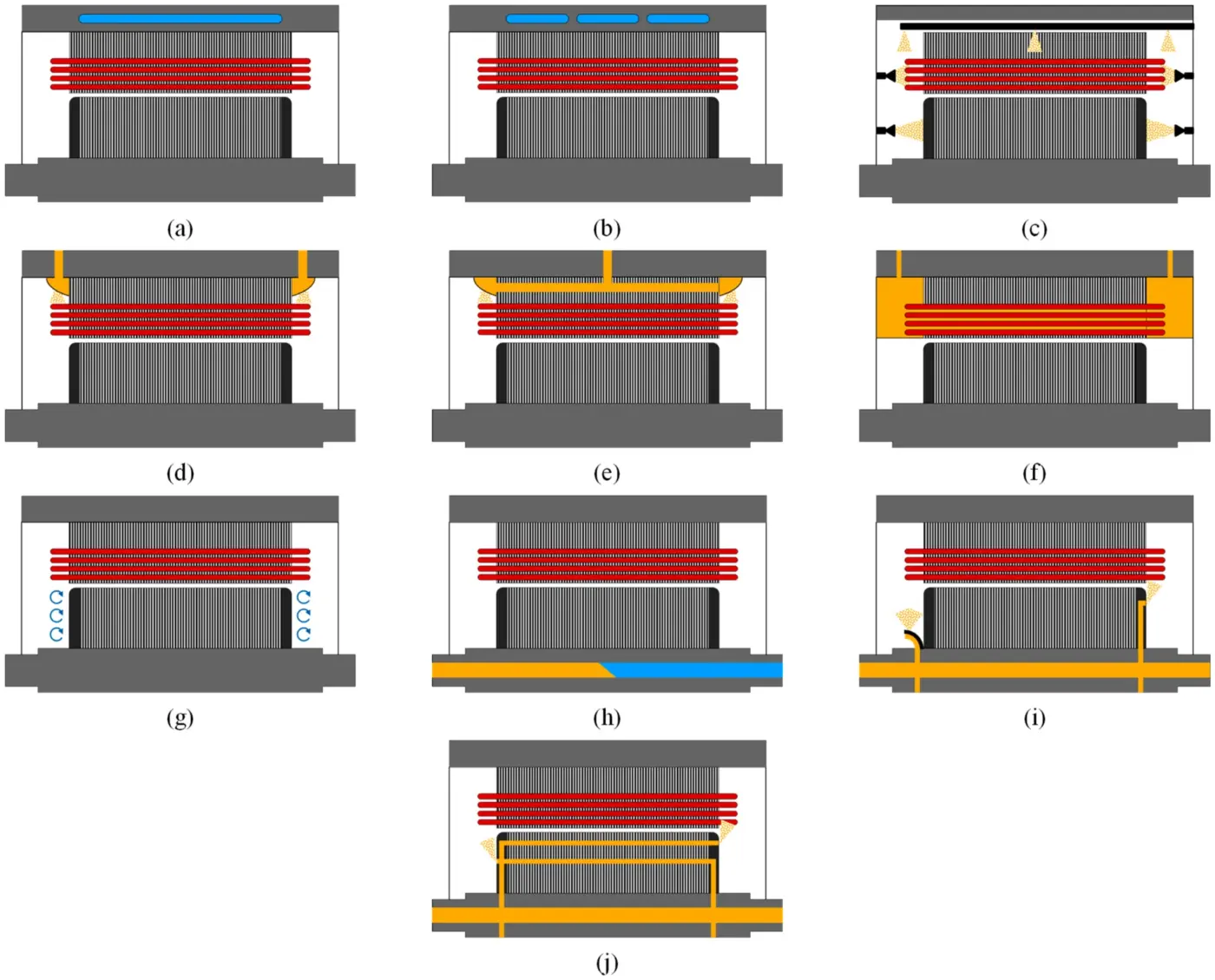
A comparison of cooling concepts of modern electric motors.
A shift is also emerging in cooling systems. While older motors were predominantly cooled using classic water jackets, newer drivetrains increasingly employ combinations of direct oil cooling for the rotor and stator. This, in turn, places higher demands on sealing and component manufacturing
The findings show that while China is an important driver for electric drivetrains, no fundamentally different technical direction has emerged compared to Europe or the USA. The differences lie primarily in the specific implementation and material choices
Need help choosing the right university or study destination?
Start your FREE JIUniversity Admission Assessment today and discover the best international study pathway for your academic goals.
Source: www.electrive.com

You may also like

Teens, screens and mental health