

Canada announces targets for new international student arrivals through 2029
Short on time? Here are the highlights:
- The government is aiming to attract 150,000 new international students per year in 2027, 2028, and 2029
- The target for 2026 is 155,000, but industry analysts believe that when full-year data is released, many fewer students will have received a study permit
- Targets are one thing, but other immigration settings and factors play a role in demand for study in Canada and how many study permits are approved
- The current focus is on attracting and retaining international postgraduate students
The Canadian government has announced temporary immigration targets for 2027, 2028, and 2029, which it believes will foster “sustainable immigration with the need for stability, predictability and economic growth.”
As per the 2027–2029 Immigration Levels Plan released alongside the federal budget on 5 November, a total of 370,000 permits will be available annually for new temporary residents in the next three years, split between 150,000 for international students and 220,000 for foreign workers entering through either the Temporary Foreign Worker Program (TFWP) or the International Mobility Program (IMP).
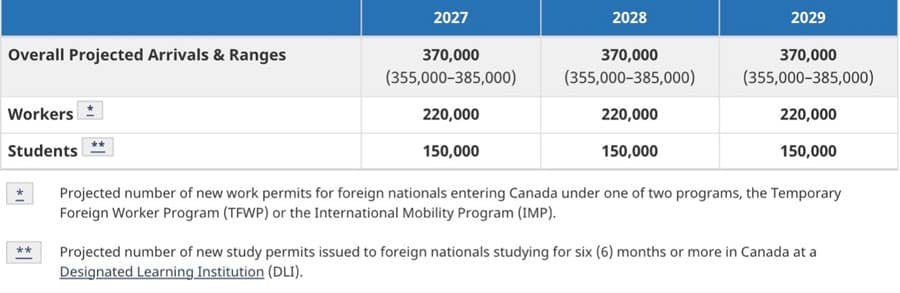
In 2026, the target for new study permits (i.e., excluding extensions) was 155,000. As of July, student arrivals in Canada were tracking well below that, and some anticipate that by the end of the year, fewer than 90,000 new permits will have been issued to international students
The government notes that:
“Temporary resident targets provide stability and predictability for provinces and territories, employers, and educational institutions while supporting short-term labour needs tied to major investments and helping Canada attract global talent while continuing to work towards the Government’s commitment to reduce the non-permanent resident population.”
In other words, the government recognises that Canada needs international researchers and workers, and it also knows that the public’s enthusiasm for more immigrants fell significantly during the early-2020s, when droves of new temporary residents arrived under immigration settings in place at the time. Public infrastructure and supports were – in some regions – not robust enough to handle the rapid population increase.
In a nutshell, Canada needs talented immigrants for its workforce, but it needs social licence for welcoming those newcomers. The government is aiming to balance those priorities
The new targets for 2027, 2028, and 2029 are part of the story, but they are only meaningful when considered alongside other strategies being used to tailor not just the overall volume, but also the kind of new students and workers entering Canada
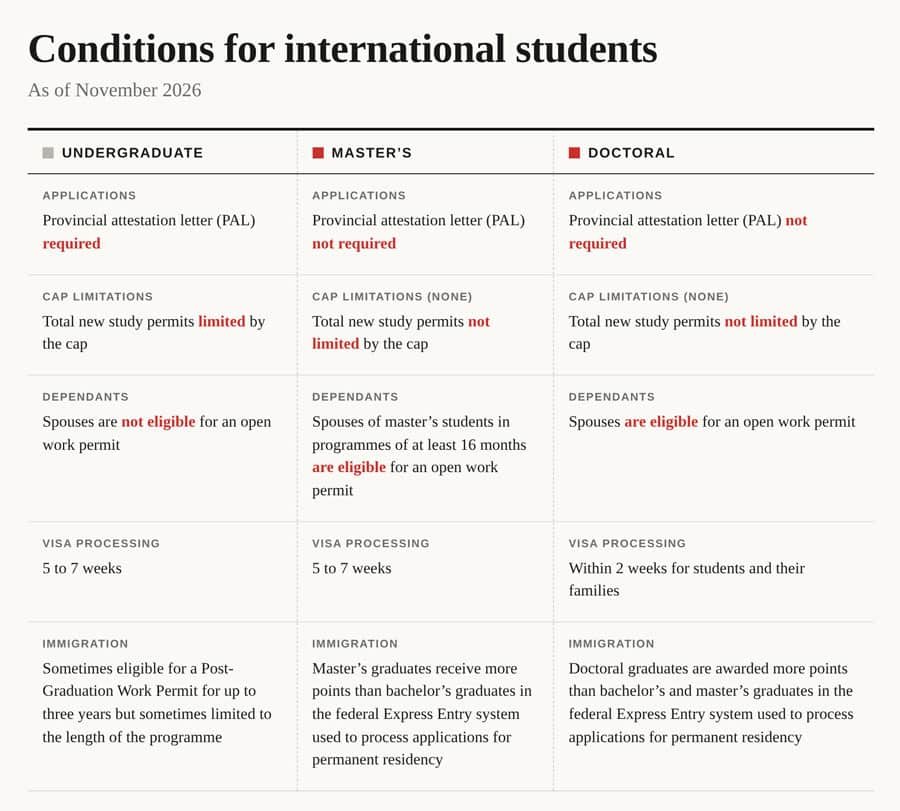
For example, there is a built-in bias towards postgraduate and public university students in terms of study permits awarded by Canadian immigration officials. The share of undergraduate students receiving grants is declining – especially for students applying to colleges rather than universities
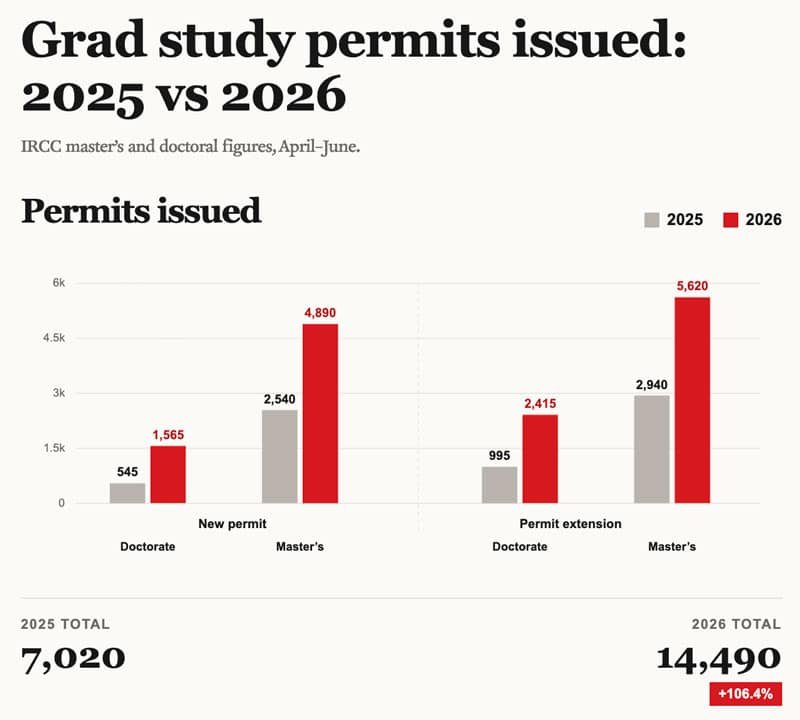
The government exempted master’s and PhD students in January 2026 after two years of including them in the cap, which first first went into force in 2024. International demand for postgraduate programmes in Canada picked up immediately. The number of study permits granted to master’s and PhD students doubled in Q2 2026 (6,455) over Q2 2025 (3,085). University Affairs reports that extensions of existing graduate study permits also increased sharply, from about 4,000 in Q2 2025 to over 8,000 in Q2 2026.
Full-year data will tell the story of whether the government’s target of 49,000 study permits reserved for postgraduate students will be met, but already we know that master’s and doctoral degree students accounted for 20% of new study permits issued between January to August 2026, nearly double their 12% share in 2025
The table below shows how Canadian immigration settings work to prioritise postgraduate students for study permits and also permanent residency applications
The university sector welcomed the news that targets would be consistent for the next three years:
“Universities Canada welcomes the government’s commitment to maintain its target of 150,000 new international student arrivals annually from 2027 to 2029, as stated in the Immigration Levels Plan. Predictable immigration policies are essential to rebuilding confidence in Canada’s international education system and attracting global talent.”
The Canadian Bureau for International Education (CBIE) also expressed support, but it added that currently, even though 155,000 spaces were made available for new international students in 2026, other factors combined so that only about half of those spaces are expected to be filled by the end of the year:
“Preserving [new study permit] targets through to 2029 sends an important signal to Canadians, international students, and partners around the world that Canada is committed to a sustainable, stable, and predictable immigration policy. This stability is critical for communities welcoming international students, educational institutions planning for the future, and students who make significant financial and personal investments based on clear pathways and reliable policies.
“As global competition for top talent intensifies, this signal alone will not be enough to attract the talent Canada needs to address acute labour shortages and build the talent pipeline it needs to fulfill its national strategies in defence, AI, critical minerals, food security, infrastructure building and nuclear energy
“With a limited number of new international study visas available each year, each of these 150,000 spaces matter. Each represents an opportunity to fill a critical workforce need, launch a new business, advance research and innovation, strengthen local communities, or contribute to long-term economic growth
“According to the most recent available data, Canada welcomed just over 65,000 new international student arrivals between January and August 2026 — putting the country on track to only reach about half of its annual target by year-end. As Canada looks to build the workforce required for long-term prosperity, international education must remain a central pillar of our talent strategy.”
<a href="https://niagaraindependent.ca/ottawa-keeps-international-student-targets-low-through-2029-and-ontario-campuses-keep-paying-for-it” rel=”nofollow noopener” target=”_blank”>The Niagara Independent offered a more pessimistic view:
“With Ottawa holding arrival targets down through 2029, Ontario’s colleges and universities have several hard years ahead. The federal Liberals let enrolment climb for years, then shut off much of the flow of new students with little time for schools to adjust. Campuses are still paying for that reversal in lost tuition, fewer programs and fewer jobs.”
In its overall supportive statement, Colleges and Institutes Canada (CICan) emphasised a need to include colleges in strategies to attract and retain students and workers for the many occupations needed by the Canadian economy:
“The budget’s focus on attracting and retaining international talent is encouraging, particularly the proposed pathways to permanent residence for those already contributing to Canada’s economy. With the 2027–2029 Immigration Levels Plan now released, CICan will continue to advocate for a “both/and” approach that recognizes the full range of talent Canada needs, including public college graduates and skilled tradespeople.”
For additional background, please see:
- “What is happening with international student numbers in Canada this year?”
- “New OECD data underlines growing competition for graduate-level international students”
Most Recent
- Canada announces targets for new international student arrivals through 2029
- UK business schools report declining international enrolments and predict the downturn will persist through 2027
- Global agent survey provides an early indication of how international student markets are taking shape this year
Most Popular
- Which countries will contribute the most to global student mobility in 2030?
- Research shows link between study abroad and poverty alleviation
- Beyond the Big Four: How demand for study abroad is shifting to destinations in Asia and Europe
Need help choosing the right university or study destination?
Start your FREE JIUniversity Admission Assessment today and discover the best international study pathway for your academic goals.
Source: monitor.icef.com
Tag:announces, Canada, International, Student, targets