Benin bronzes made from metal mined in west Germany, study finds
This article is more than 3 years old
Brass used for west African artworks was acquired from manilla bracelets, the grim currency of the slave trade
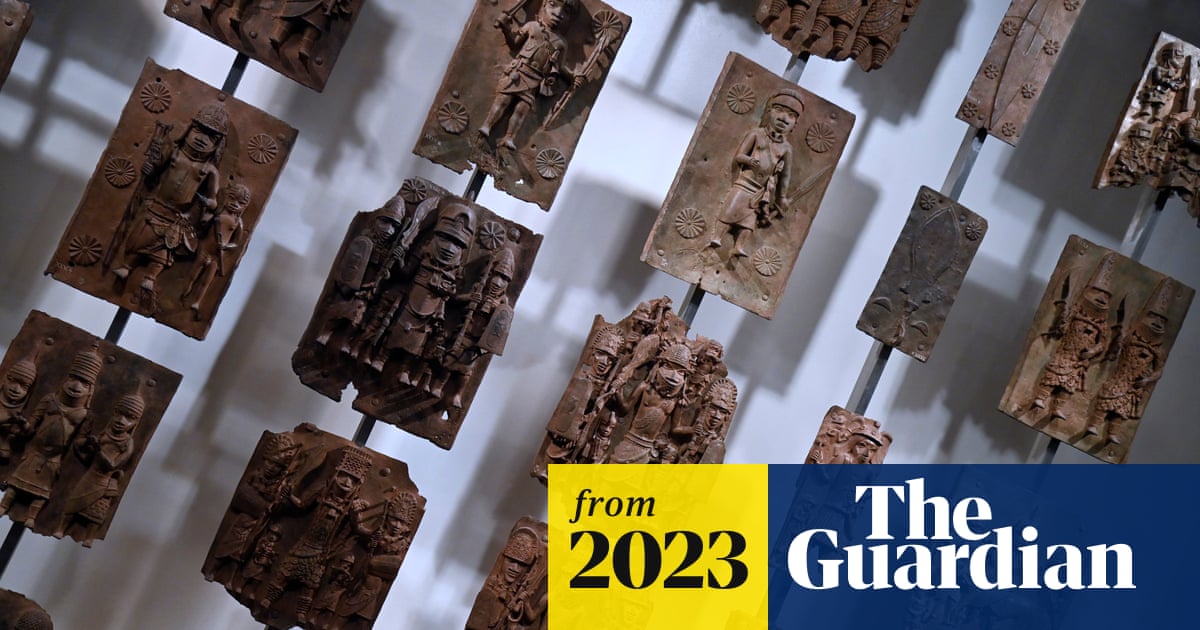
Scientists have discovered that some of the Benin bronzes were made with metal mined thousands of miles away in the German Rhineland
The Edo people in the Kingdom of Benin, modern Nigeria, created their extraordinary sculptures with melted down brass manilla bracelets, the grim currency of the transatlantic slave trade between the 16th and 19th centuries
While rarely found in archaeological excavations on land, they have been retrieved in substantial numbers from the wrecks of vessels that had been transporting them
In carrying out the largest study of these bracelets, a team of German researchers compared their metal with metallic ores and mines across Europe before tracing them to the Rhineland in western Germany
Dr Tobias Skowronek, who led the study, said: “This is the first time a scientific link has been made … The Benin bronzes are the most famous ancient works of art in west Africa. Where the enormous volumes of metal came from and how Benin got its brass has long been a mystery.”
My ancestors were pillaged to bring the Benin bronzes to England. It is white supremacy that keeps them here | Noah Anthony Enahoro
Read more
Dr Sean Kingsley, an archaeologist and editor-in-chief of Wreckwatchmagazine, which specialises in the sunken past, said: “[Skowronek has] discovered that the Benin bronzes were made from metal mined around Cologne. Nobody had a clue and it’s quite an eye-opener. It’s a big deal within the very high-profile Benin bronzes art and history world.”
Hundreds of Benin bronzes were seized by British forces in 1897 when the royal court of Benin was razed to the ground. Today, the sculptures are in museums and galleries in Britain and elsewhere
Nigeria has long called for their return. Germany is one of the few countries that is actively repatriating its bronzes. Other institutions that have done so includethe Horniman Museum in London
Manillas, derived from the Latin for hand or bracelet, were a “currency” used by Britain, Portugal, Spain, the Netherlands, France and Denmark to trade with west Africa in gold and ivory, as well as enslaved people
The scientific study focused on 67 examples collected from five shipwrecks off the UK, Spain, Ghana and the US. Dating between 1524 and 1843, these were ships of English, Portuguese and Dutch origin. They include a Royal African Company slaver that went down in the Channel
Skowronek, based at the Technical University of Georg Agricola in Bochum, Germany, said: “Manillas were manufactured in staggering volumes. A contract between the German Fugger merchant house and the Portuguese king, dating back to 1548, lists an order for 1.4m manillas to be made ready within three years … Between 1519 and 1522, Lisbon sent 150,000 manillas a year to their trading fort at Elmina on the coast of Ghana, the heart of the gold and slave trade.”
skip past newsletter promotion
after newsletter promotion
He added: “European societies designed [manillas] solely to buy west African goods, from humans to animal hides … In the 16th century, the German mines were thought to be too exhausted to make it worthwhile deep mining and pumping out rivers of water. But the great volume of manillas that the slave trade needed made industrialists think again.”
Last October, the Guardian reported on his team’s previous findings, that the early British enslavers
The latest findings will be published on Wednesday in the journal Plos One. Kingsley’s Wreckwatch is also screening a short filmabout the Benin bronzes story
Explore more on these topicsShare
Reuse this content
Need help choosing the right university or study destination?
Start your FREE JIUniversity Admission Assessment today and discover the best international study pathway for your academic goals.
Source: www.theguardian.com

You may also like

Dr. Jessica Parr and PhD Student Halimat Haruna Conduct Research in Benin