Benin Built Morden Markets. Ghana Is Trying To Do The Same But Are We Ready To Change?
Benin Built Morden Markets. Ghana Is Trying To Do The Same But Are We Ready To Change?
ArticleMON, 14 SEP 2026
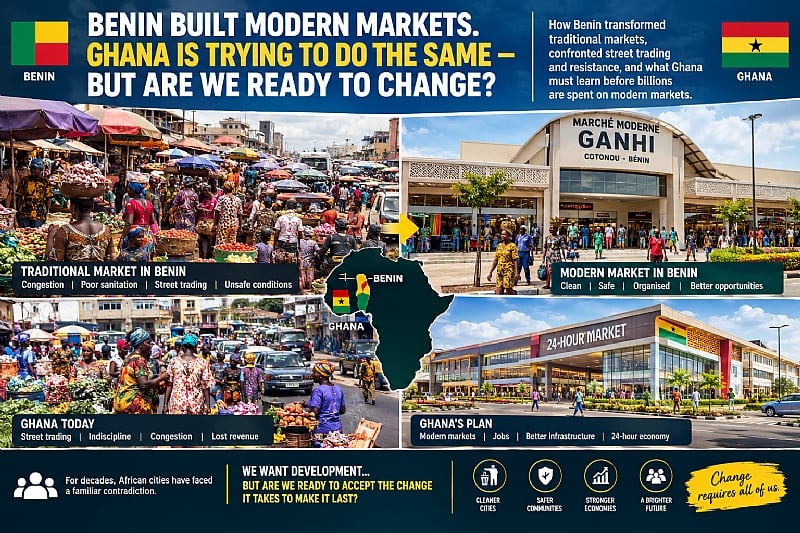
Benin modernised its markets by confronting resistance, street trading and indiscipline. Ghana now faces the same test. We demand development, but resist the discipline required to sustain it. Before billions are spent, one question must be answered: Are we ready to change not just demand change?
How Benin transformed traditional markets, confronted street trading and resistance, and what Ghana must learn before billions are spent on modern markets
For decades, African cities have faced a familiar contradiction
Citizens demand development. They complain about poor sanitation, traffic congestion, flooding, unsafe markets, fire outbreaks, inadequate toilets, poor drainage and chaotic street trading
But when governments attempt to demolish, relocate or rebuild the very structures responsible for these problems, resistance often begins
This is the uncomfortable question Ghana must now confront:
Do we genuinely want development or do we only want the finished product without accepting the disruption required to create it?
The experience of neighbouring Benin provides a fascinating case study
And Ghana’s rapidly expanding programme of modern and 24-hour markets makes the question particularly urgent
THE OLD BENIN MARKET WAS NOT BORN MODERN
To understand what happened in Benin, one must first understand the history of its markets
Traditional markets were not simply places where people bought and sold goods. They were social institutions
Markets such as Dantokpa in Cotonou grew organically into enormous commercial ecosystems serving Benin and neighbouring countries
Dantokpa’s history stretches back decades. The market was relocated several times as it expanded before settling at its present location in 1963. Over the years, however, its growth became increasingly difficult to control. Informal structures multiplied around the formal market, while congestion, sanitation and public-space problems intensified
The same phenomenon is familiar across West Africa
A small market is established.More traders arrive.More customers arrive.Traders expand beyond their allocated spaces
Walkways become selling points.Roads become trading spaces.Drainage channels become storage areas.Vehicles compete with pedestrians.Then the government is blamed for congestion
This is where the Benin story becomes particularly interesting
THE TALON GOVERNMENT DECIDED THAT THE OLD MODEL COULD NOT CONTINUE
When President Patrice Talon’s government launched its market-modernisation programme, the objective was not simply to paint old structures or construct a few new stalls
The ambition was much bigger.The government planned a network of 35 modern urban and regional markets across Benin
The programme was incorporated into the government’s 2016–2026 Action Programme and was designed around modern infrastructure, sanitation, security, accessibility and improved trading conditions
The government understood something important:
You cannot create a modern city while continuing to operate markets according to an uncontrolled informal system
And that meant confronting one of the most politically sensitive groups in African urban life:
market traders particularly women.BUT THE TRADERS DID NOT SIMPLY WELCOME THE IDEA
The transition was not painless.For many traders, the market was their livelihood, their family business, their social network and sometimes their only
Moving them meant uncertainty.Would they receive another stall?Would customers follow them?Would they be able to afford the new charges?
Would government actually complete the project?
Would they return to their original location?
These were legitimate fears.In 2018, President Talon personally met more than 1,000 market women and men in Cotonou. Among the issues discussed were microcredit, construction of new markets and the proposed relocation of Dantokpa. The women were told that authorities would involve them in discussions concerning their relocation
The government subsequently created temporary relocation arrangements for traders affected by the construction of the new markets
For the first phase, 23 markets were under construction, and traders were temporarily relocated so construction could take place, particularly because many new markets were being built on existing market sites
This is an important distinction.Benin did not simply say: “Move because we want to build.”
It increasingly developed a system involving relocation sites, identification of traders, engagement and later allocation of spaces
But the government was also willing to enforce public-space rules
In 2021, police cleared illegally occupied public spaces around Dantokpa, removing traders who had expanded into areas designated for public movement
So there was both:consultation and enforcement.And Ghana needs to understand that combination
THE CATERPILLAR QUESTIONThere is a popular narrative that Benin simply brought bulldozers and caterpillars to throw all market women out
That story contains an element of truth about forceful clearance of illegally occupied spaces, but it is too simplistic to describe the entire Benin market-modernisation programme accurately
Official records show that the government also established temporary relocation sites, engaged traders, conducted identification exercises and developed new locations before major relocations
That matters.Because Ghana should not learn the wrong lesson from Benin
The lesson is not:”Bring bulldozers and crush everybody.”The lesson is:”Development requires planning, relocation, consultation, compensation or transitional arrangements where appropriate, and ultimately enforcement.”
Without enforcement, consultation can become an endless excuse for refusing change
Without consultation, enforcement can become an injustice
Successful development requires both.AND THEN SOMETHING UNEXPECTED HAPPENEDSome of the very people who were sceptical about the modern markets eventually began praising them
In July 2025, groups of market women from several modern markets gathered in Cotonou to publicly express appreciation for the government’s market-modernisation programme
Women from markets including Pahou, Gbégamey, Cadjèhoun, Mènontin, Ganhi, Wologuèdè, Tokplégbé, Aïdjèdo and others described the new facilities as a major improvement over the old conditions
Their complaints about the old markets had once been familiar:
Poor sanitation.Standing water.Unsafe structures.Inadequate facilities.Insecurity.Poor working conditions.Today, many of those same traders are operating in facilities with organised stalls, toilets, waste-management systems, storage facilities, security arrangements and other amenities
Ganhi, for example, reopened in December 2024 with 509 commercial spaces, restaurants, shops, hundreds of produce stalls, meat and fish sections, cold storage, waste facilities, photovoltaic systems and surveillance infrastructure
At Aïdjèdo, beneficiaries publicly celebrated the new market as a safer and more attractive environment for their businesses
That is the paradox of development.The bulldozer is hated when it arrives.The building is celebrated when it is finished
BUT BENIN’S STORY IS NOT PERFECTThis is where Ghana must be careful.The Benin model has also faced serious questions
The relocation of Dantokpa has been particularly controversial and complicated
The government announced the relocation project years ago, but the process took much longer than initially anticipated. By 2025–2026, authorities were still working through the relocation of traders and the organisation of new commercial hubs
Government officials have increasingly relied on direct consultations with traders to address fears and misinformation surrounding the relocation
And independent reporting has raised questions about whether the planned spaces are sufficient for all traders connected to the Dantokpa ecosystem
This is crucial.Modern infrastructure alone does not solve urban commerce
You also need:adequate capacity;affordable rents;transparent allocation;transport access;customers;security;sanitation;enforcement;parking;storage;waste management;and a system preventing traders from simply returning to the streets
Otherwise, five years later, Ghana or Benin could have a beautiful modern market surrounded by another informal market
NOW LOOK AT GHANAGhana is currently standing at almost exactly the same crossroads
President John Dramani Mahama’s government has embarked on an ambitious programme to construct modern multipurpose markets under the 24-hour economy initiative
The stated vision is significantly broader than traditional market construction
The proposed facilities are expected to incorporate banking, storage, security, fire protection, restaurants, clinics, crèches and other services. The government has announced a target of modern markets across all 261 districts
At Agbogbloshie, for example, the proposed 24-hour market is expected to include shops, stalls, warehouses, cold stores, restaurants, security and fire posts, a clinic, pharmacy, daycare centre and even a women’s bank
At Boete in Obuasi East, the planned facility similarly incorporates healthcare, security and modern commercial facilities
This is not merely about giving traders prettier shops
It is an attempt to redesign the economic geography of Ghanaian towns
BUT HERE COMES THE GHANAIAN PROBLEMThe moment government talks about demolition or relocation, anxiety begins
At Ashaiman, traders strongly opposed the proposed demolition of the existing market and asked for renovation instead
Their concerns included the loss of stalls, livelihoods and uncertainty about how the new facility would be allocated. They also demanded guarantees that the replacement facility would have enough space for existing traders
At Makola, traders similarly expressed concerns about relocation and the effect on their businesses
Government responded by emphasising consultation and protection of livelihoods
Eventually, in August 2026, the Accra Metropolitan Assembly and traders reached an agreement for temporary relocation arrangements ahead of the redevelopment of the 31st December Market, including the principle that existing shop owners would receive the first option for allocation after completion
This is progress.But Ghana must ask a deeper question.WHY DO WE WANT MODERN MARKETS BUT RESIST THE PROCESS THAT CREATES THEM?
This is the uncomfortable conversation.If a trader occupies a pavement today and government clears it, the trader complains
If government leaves the pavement occupied, pedestrians complain
If government builds a market and asks traders to relocate, some complain
If government does not build a market, the same citizens complain about congestion and poor infrastructure
If government demolishes an unsafe structure, people complain
If government allows the unsafe structure to remain and it catches fire, people ask:
“Where was the government?”So what exactly do we want?ARE GHANAIANS AGAINST DEVELOPMENT OR AGAINST LOSING WHAT THEY HAVE?
Perhaps the answer is more complicated.A trader is not necessarily against development because she opposes demolition
She may simply be protecting her livelihood
This distinction is important.A woman who has spent 20 years building a customer base in a particular location cannot be expected to hear “modernisation” and immediately celebrate
But there is another side to the argument
Can the individual economic interest of one trader permanently override the collective interest of an entire city?
That is the question Ghana rarely asks.KEJETIA SHOULD HAVE TAUGHT US THIS LESSON
Ghana has already lived through this debate
The redevelopment of Kumasi’s Kejetia area generated intense resistance
In 2015, traders protested relocation arrangements connected to the redevelopment and openly confronted the Kumasi Metropolitan Assembly leadership. Contemporary reports described curses, accusations and traders declaring that they would not move
Academic research later documented the complexity of the resistance, showing that traders adopted different strategies including resistance, compliance and attempts to remain economically active in the central business district
Yet today, Kejetia is one of the most recognisable modern market facilities in Ghana
And the irony is almost impossible to ignore
The project that was once resisted eventually became part of the city that people proudly identify with
Meanwhile, Kumasi still struggles with market congestion where unfinished projects and delays leave traders spilling into streets and pavements. Recent reporting on stalled Kejetia Phase II and Krofrom Market projects highlighted exactly this problem
So perhaps the lesson is not simply that Ghanaians resist development
The lesson may be:We resist uncertainty more than we resist development
THE HARD QUESTIONS GHANAIAN MARKET WOMEN MUST ASK THEMSELVES
If the government gives you a modern shop with proper drainage, toilets, electricity, security, storage and fire protection, why should you reject it merely because moving there temporarily is inconvenient?
If government promises you a replacement stall, should you not demand transparency instead of demanding that the old structure remain forever?
If your current market floods every rainy season, where is the dignity in defending the flood?
If your goods are displayed on the roadside, pedestrians cannot walk and vehicles cannot move, who owns the road?
If the government builds a modern market but traders refuse to occupy it, what happens next?
If everyone demands development but nobody accepts disruption, who exactly is supposed to build the future?
And perhaps the most uncomfortable question:
Do some traders want modern markets or do they want modern markets without modern rules?
Because a modern market cannot operate according to an old culture of indiscipline
AND THIS IS WHERE GHANA MUST LEARN FROM BENIN
Benin’s most important lesson is not the architecture
It is institutional discipline.A government can construct the most beautiful market in West Africa
But if traders return to the pavements six months later, the investment has failed
A market-modernisation programme therefore needs five things
1. Build before forcing relocationGhana should avoid the mistake of moving people into uncertainty
Where practical, temporary trading areas should be prepared before demolition
Benin used temporary relocation sites during construction of its modern markets
2. Identify legitimate tradersWho was actually trading in the old market?
Who owns a shop?Who is a subtenant?Who is an illegal occupant?Who is a hawker?Who has been operating there for years?These questions must be answered before allocation
3. Make allocation transparentNothing destroys confidence faster than rumours that political party supporters, wealthy businessmen or connected individuals will receive the best shops
Every trader should know:Who qualifies?How are stalls allocated?How much will they cost?What happens to existing shop owners?Ghana’s recent Makola agreement, which provides existing shop owners the first option for allocation after redevelopment, is an example of the type of assurance that can reduce anxiety
4. Enforce the rules after constructionThis is perhaps the most important lesson
If the new market has 5,000 stalls, but another 3,000 traders occupy the surrounding roads, Ghana will simply recreate the problem
The pavements must remain pavements.Drainage channels must remain drainage channels
Roads must remain roads.Markets must remain markets.5. Give traders ownership of the transformation
Government should not treat market women as obstacles
They are economic actors.Many are mothers, employers, wholesalers, retailers and taxpayers
They should therefore be partners in the transformation but partnership must come with responsibilities
GHANA ALSO NEEDS TO LEARN WHEN CONSULTATION MUST END
Consultation is important.But consultation cannot mean permanent veto power
If government consults for five years and nothing changes, development becomes hostage to the loudest group
The state must listen.But after listening, it must decide.And once the decision is lawful, transparent and properly implemented, enforcement must follow
That is what separates a functioning city from a permanently informal one
BENIN’S GREAT TRANSFORMATION AND ITS WARNING FOR GHANA
Benin has demonstrated what happens when a government treats markets as urban infrastructure rather than merely places where people sell tomatoes, clothes, meat and electronics
Its modern markets are designed around sanitation, safety, accessibility, waste management, storage and organised commerce
And the transformation is continuing.The reopening of Ganhi demonstrated what a redesigned market can look like
The relocation of Dantokpa demonstrates something equally important:
Even after building modern markets, urban transformation remains difficult
That is perhaps the greatest lesson Ghana should take
AFRICA’S REAL DEVELOPMENT PROBLEM MAY NOT BE LACK OF MONEY
Perhaps our biggest problem is not always the absence of development plans
It is the conflict between individual convenience and collective progress
Everybody wants a good road.But not if the road passes through their property
Everybody wants a clean city.But not if sanitation enforcement affects their business
Everybody wants modern markets.But not if they have to move temporarily
Everybody wants traffic-free roads.But some want to sell on the pavement.Everybody wants government to enforce the law
Until enforcement affects them.Then suddenly:”My human rights!”Rights matter.But responsibilities matter too.A society cannot demand rights from government while refusing the responsibilities necessary to make public infrastructure work
THE QUESTION GHANA MUST ANSWER BEFORE THE CATERPILLARS ARRIVE
Modern markets will not succeed simply because government builds them
They will succeed when government changes the behaviour surrounding them
Ghana should therefore not copy Benin blindly
It should study what worked, what failed, what created resistance and what ultimately produced acceptance
The government must provide relocation arrangements
It must consult.It must protect legitimate livelihoods.It must guarantee transparent allocation
It must prevent political capture.And then, when the new market is ready, it must enforce the rules without fear or favour
Because if the government builds a GH¢100-million modern market and allows traders to return to the pavements, Ghana will have built an expensive monument to indiscipline
SO, DO GHANAIANS REALLY WANT DEVELOPMENT?
That is the question nobody wants to ask
Perhaps we do.But perhaps we want development on our own terms
We want the new market, but not the relocation
We want clean streets, but not the enforcement
We want modern cities, but not the discipline modern cities require
We want Singapore-like infrastructure with behaviour that sometimes undermines the very infrastructure we build
And that contradiction cannot continue forever
Benin’s experience offers Ghana a mirror
The mirror asks:When the bulldozers come, will Ghana see them as enemies or as part of the painful machinery of transformation?
When the modern markets are completed, will today’s protesters become tomorrow’s beneficiaries?
And when the ribbon is cut, will Ghana finally enforce the rules or will the same old street trading simply grow around a brand-new building?
Because the real test of Ghana’s modern-market programme will not be the size of the buildings
It will be whether Ghanaians are prepared to change with them
A modern market cannot create a modern trading culture by itself
A modern city requires modern infrastructure but it also requires modern civic discipline
And perhaps that is the lesson Ghana should learn from Benin:
Development is not only about what government builds. It is also about what citizens are willing to change
The uncomfortable question is no longer whether Ghana can build modern markets
The real question is: CAN GHANA BUILD THE DISCIPLINE REQUIRED TO KEEP THEM MODERN?
By:Patrick Belebang Yagsori+233240292413[email protected]
Need help choosing the right university or study destination?
Start your FREE JIUniversity Admission Assessment today and discover the best <a href="https://jiuniversity.com/open-call-for-international-scholarships-programme-macedonia-fundsforngos/” title=”Open Call for International Scholarships Programme (Macedonia) – fundsforNGOs”>international study pathway for your academic goals.
Source: www.modernghana.com

You may also like

European education powerhouses rocked by falling scores in global study