
European study tour inspires Australian growers
20 Australian vegetable and onion growers spent 10 days in the UK and the Netherlands to see how manufacturers and growers incorporate automation and robotics on commercial farms
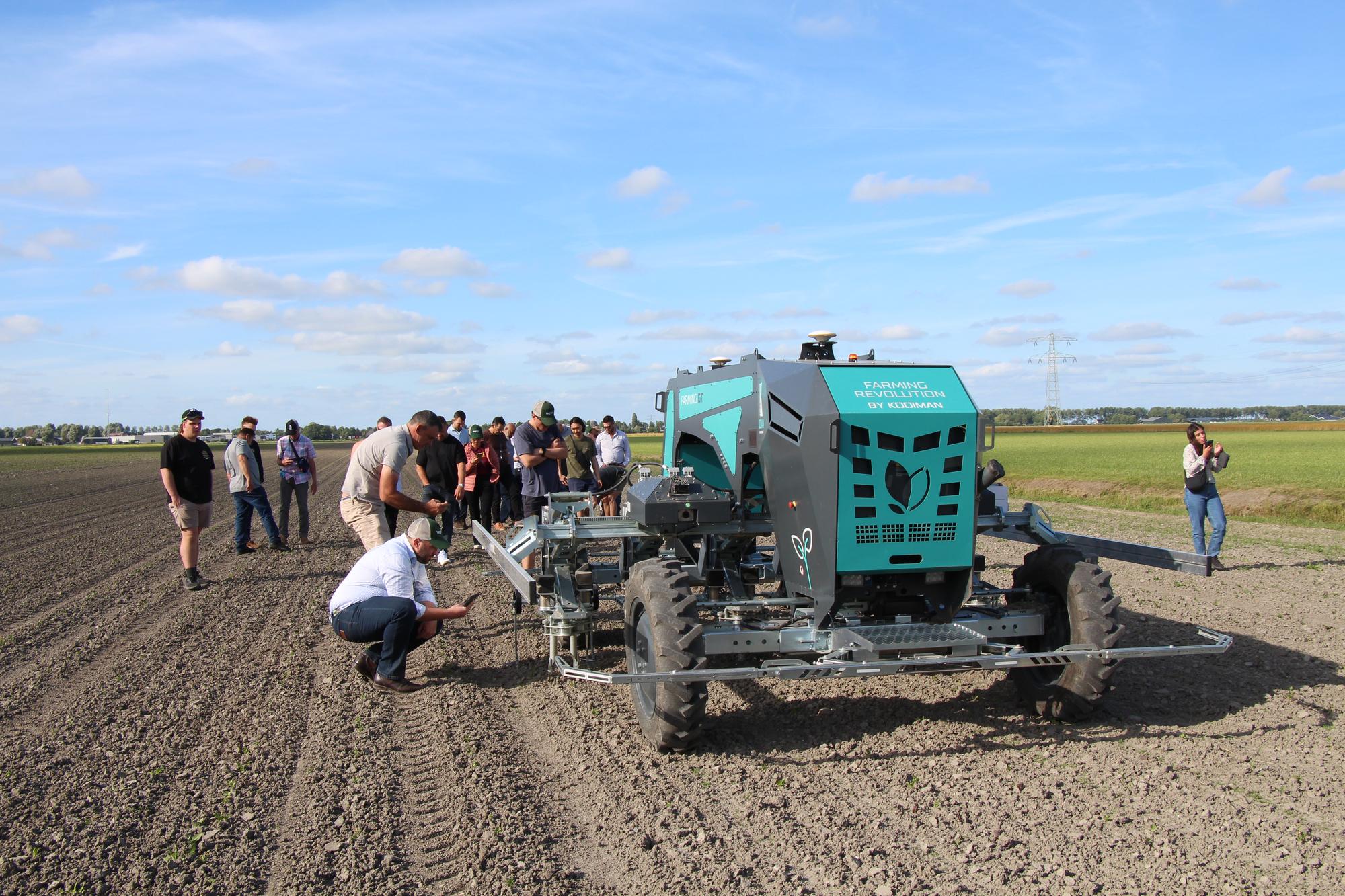
During the 10 days study tour through the UK and the Netherlands, organised as part of the VegMech project and facilitated by GOFAR, 20 Australian vegetable and onion growers got first-hand insights into how European growers use the latest precision and robotics technology on their farms. The project VegMech is led by the Department of Primary Industries (Queensland) and funded by Hort Innovation. Future Farming joined them during their visit to Dutch farmer Ted Vaalburg who farms about 220 hectares of cropland growing among others 80 hectares of conventional celeriac (celery root) and 45 hectares of organic celeriac.
Robotic hoeing with Farming GT
After setting ground on the European mainland on the afternoon of 3 July, the group travelled to one of Farmer Ted’s fields with young celeriac plants where they were welcomed by Maurice Gohlke, co-founder and co-CEO of Farming Revolution, the German manufacturer of the Farming GT hoeing robot. Ted Vaalburg has been running a Farming GT since recently to mainly help clear his celeriac and pumpkin fields of weeds.
Some 40 Farming GT field robots have been sold so far in Europe. About one third of these are active in sugar beet fields and other arable crops, another third works in cabbages, broccoli, celery and celeriac while the remainder is used by farmers in fields with fine herbs and alike
Depending on the type of crop and field, and on the weed pressure, one Farming GT robot can generally hoe 8 to 10 hectares per day. It is electrically driven and backed up by a one-cylinder diesel engine as a range extender. The software allows you to select and set specific parts of fields where the engine should not start or run. For instance, if it is working in urban areas close to houses
Labour issues and sustainable weed management
While the group was listening to the presentation of Farming Revolution’s co-founder, two of the growers took time to (anonymously) elaborate on their farm operations and the interest in precision agriculture and automation of weed management
One of them runs a 400-acre (162-hectare) conventional farm growing crops such as leeks and radicchio and hopes to find solutions to manage the weed pressure while keeping the labour requirement in hand. “We focus on soil and crop health by implementing cover crops and by limiting the use of crop protection products, herbicides, as much as possible. We don’t have weeds that are resistant to herbicides, but try to decrease the herbicide use from a crop health and vitality point of view. Especially with leeks, where herbicides affect the wax layer of the leaves. We do apply a pre- and post-emergence burn-off. And we use cultivators for tackling weeds mechanically but those tend to work too deep. Which doesn’t go well with the cover crops we have. It’s not our aim to get rid of weeds entirely. As long as the weeds don’t get in the way during harvesting. As (skilled) labour is difficult to obtain and keep, I eventually prefer to manage weeds autonomously. From a functional perspective, I’m also interested in laser weeding.”
Laser weeder slower than expected
Another farmer is growing, amongst others, baby leaf, herbs and transplant lettuce on 1,600 acres (650 hectares) of farmland. 40 to 45 per cent of the acreage concerns organic produce. “We invested in a 2 metres wide LaserWeeder from Carbon Robotics last year. A generation 2 machine with a limited working width because of road transport and the considerable investment. I see other manufacturers coming onto the Australian market now, but at the time we invested in it, Carbon Robotics was the only serious option. We opted for laser weeding because of the precision, the ability to tackle weeds really close to the plants. I don’t really mind what type of laser it is, as long as it works well and there’s professional backup and service. And the latter is very good.
Both from the US and the Australian branch. It costs us some €100,000 per year, but it’s worth it. I only see one drawback, and that’s the slow operating speed. It works slower than expected which affects the operator’s motivation. I won’t just let anyone operate a million Australian dollar machine and finding operators for it becomes increasingly challenging. Having an autonomous tractor in front could help tackle that challenge. I might be disappointed about the working speed, but for me it’s the weeding result that counts. And for that reason, I’m actually considering buying a second laser weeder.”
More about
08:00 |
News
Norwegian robotics firm AutoAgri rebrands as Uncrew Robotics
10-07 |
News
XAG launches RM80 unmanned mower, unveils new X Series drone system
Premium
30-06 |
Photo report
DLG Feldtage: hot, dusty and relatively quiet
Premium
24-06 |
Article
Australian vegetable farm puts 2 weeding technologies to the test
Need help choosing the right university or study destination?
Start your FREE JIUniversity Admission Assessment today and discover the best international study pathway for your academic goals.
Source: www.futurefarming.com
Tag:Australian, European, inspires, study, tour

You may also like