

Global agent survey provides an early indication of how international student markets are taking shape this year
Short on time? Here are the highlights:
- Agents’ responses point to continuing demand for study abroad
- However, given volatile policy settings and compliance regimes in the Big Four, agents’ confidence that student numbers will increase is lower than in previous years of the survey
- Agents say they need fast, accurate, clear responses from institutions more than ever amid this stricter regulatory context
- Affordability and visa issues top students’ list of concerns about study abroad
- Student interest in Australia and the US decreased from 2025
- The UK is stable, and interest in Canada improved significantly
The findings of the 2026 ICEF Agent Voice Survey were released at ICEF Berlin this week, and as always, this annual research initiative shows how much can change in our industry in a short span of time. The 2026 edition of the long-running survey includes four years of tracking data for some questions, which is particularly useful for understanding the evolution of student mobility from the perspective of agents.
This year was one in which international student recruitment to the Big Four became even more challenging, and we see that playing out in many of the survey’s findings
The 2026 survey was conducted with over 900 agents in 109 countries
On a positive note, more than half of agents expect overall foreign enrolments to stay the same or grow in 2027, especially for the graduate (79%) and undergraduate/foundation levels (78%). But the average is pulled down by much lower proportions expressing optimism about language, vocational/certificate, and K–12 studies, as shown in the chart below
Confidence in next-year enrolments is down from previous years, especially when it comes to language and vocational placements. In 2023, over half of agents predicted that more students would enrol in language enrolments in the coming year, whereas in 2026, the proportion fell to just over a quarter (28%). For vocational studies, optimism fell from 60% in 2023 to 26% this year, with the steepest decline from 2023 to 2024. That was a year in which policies were introduced in Canada and Australia that affected vocational/private college providers, especially.
As in previous rounds of the survey, costs and visas top the list of barriers or worries for students, and agents say these matter more than last year. The third-most common concern is post-study opportunities, which rose significantly from last year. Safety and reputation have become more important over the past four years. The tense geopolitical environment in 2026 is likely a reason that safety is more of a priority now.

Agents were asked whether students ask for career guidance, and 62% said they do before studies and 49% said they do during or after their programmes. This finding highlights the need for institutions to communicate clearly with agents about programme alignment with skills shortages and employer demand. This alignment has become a major influence on international students’ decision-making
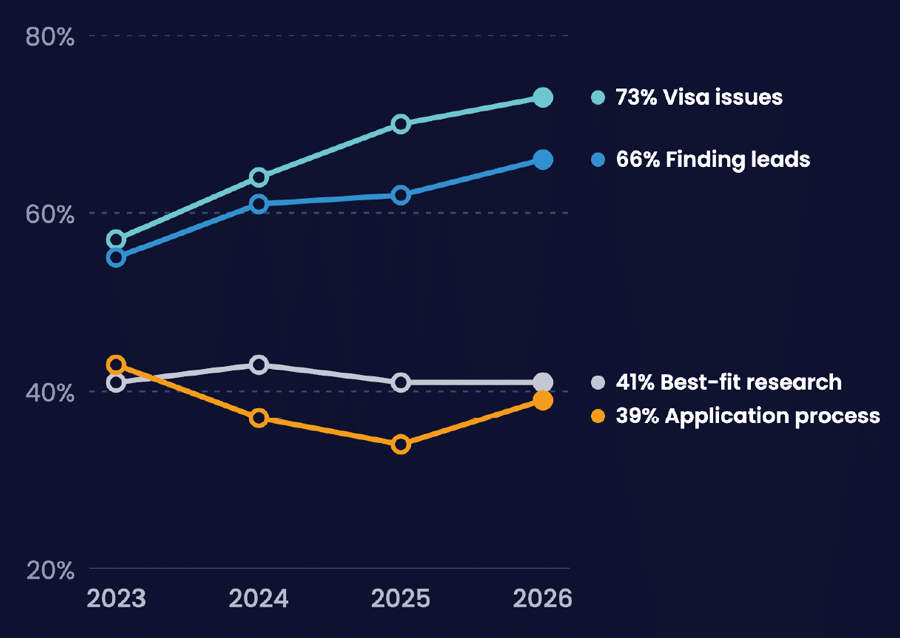
Agents are increasingly required to have deep knowledge of (1) frequently changing visa rules and visa approval rates, and (2) Big Four destinations’ compliance regimes, which also change frequently and which affect the markets and student profiles institutions are focused on. It is no surprise that “visa issues” and “finding leads” rose to 73% and 66% as agent concerns in 2026. Nor is it surprising that “application process” became more of concern in 2026 than in 2025, as agents must work even harder – and often amidst uncertainty around visa processing – to help genuine students to prepare strong applications. This is particularly true in South Asian markets, where students have been especially likely to be refused in 2026.
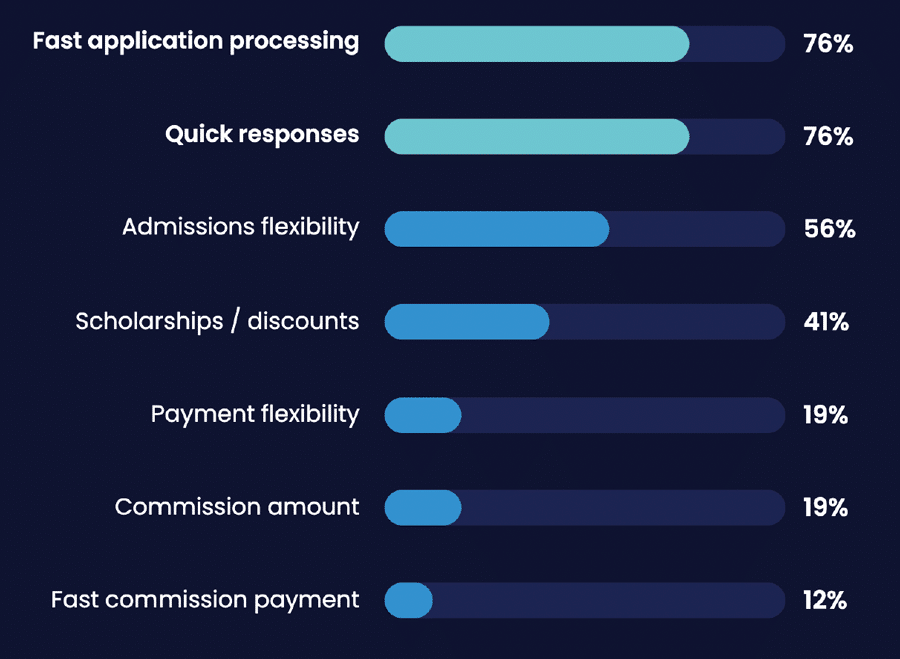
With heavier workloads than ever, agents say the most effective supports from institutions are fast application processing and quick responses. Visa rules and compliance regimes have been shifting so rapidly that agents need virtually real-time information from institutions to help them advise students and target the right leads. In addition, more than three-quarters of agents would like their teams to receive more training from partner institutions.
The findings show that demand for theUK is higher than for Canada, Australia, and the US – and more stable over time. Interest in the UK is growing in South Asia, with 43% of agents saying demand has increased from this region. Still, compared with 2025, when an average of 48% of agents were seeing more students interested in the UK, this fell to 31% in 2026. Affordability concerns may be a principal reason for this trend.
Student interest in Canada is strengthening. In 2025, only 18% of agents said there was more demand for Canada than in the prior year, and 58% said there was less. In 2026, 27% reported more demand and 34% reported less. Students in Europe and Central Asia are particularly more likely to be considering Canada (44%). Canada was the only destination of the Big Four where global student demand increased more in 2026 than in 2025.
Australia has lost ground since last year, with 42% of agents saying student demand has decreased,13 percentage points higher than in 2025. Not surprisingly – given high visa refusal rates for South Asian students – fully half of agents said interest from this region is down compared with last year. However, agents are seeing more European and Central Asian students considering Australia (53%) than last year, and there is a strong increase from Latin American students as well (43%).
Fully half (50%) of agents said demand is lower than last year for the US, similar to the proportion saying this in 2025 (48%). The survey also asked where students who decide not to go to the US apply to instead. Canada is the most common option (60%), followed by Australia (57%) and the UK (53%). Germany (22%) and New Zealand (21%) were also on the list of top five destinations chosen when students’ interest diverts from the US.
In terms of destinations capturing more attention from students, New Zealand, Spain, Italy, Malaysia, and Germany lead the pack. This coincides with growing international enrolments in all these countries over the past couple of years. Interestingly, however, the number of agents reporting that they have expanded the number of destinations into which they place students over the past two years was lower in 2026 (66%) than in 2024 and 2025. This has been a challenging year for many agents given greater restrictions in the Big Four, so they may be less able to consider business expansion at this time.

The Koala News made a great point about the 2026 findings:
“What emerges is a picture not of collapse, but of a market undergoing a significant reset …. Agents are not saying students have disappeared. They are saying the era of easy growth has ended.”
Another astute observation is that:
“What makes the 2026 Agent Voice findings particularly significant is that they challenge both the industry’s optimists and pessimists
“The optimists have argued that global demand for international education remains virtually unlimited. The pessimists have pointed to policy tightening and geopolitical uncertainty as evidence of an impending decline
“The survey suggests neither side is entirely right
“Demand remains strong. Global projections continue to point toward millions more internationally mobile students over the coming decade. Yet that demand is becoming more selective, more price-sensitive and more responsive to policy settings than at any point in recent years.”
This year’s ICEF Agent Voice findings leave educators working with accredited agents (who are increasingly sought out by students – 34% of agents say they are often or always asked if they are accredited and 34% say they are at least sometimes) with these key takeaways:
- Expect steady demand but plan around lower optimism than in previous years.
- Recognise demand is shifting. Work with agent partners to identify core destination strengths rather than rely on historic appeal.
- Reduce uncertainty. Give agents clear, early information on visas and rule changes, and help them find qualified leads.
- Respond quickly and be clear. Speedy responses, fast application processing, and clear guidance are what agents ask for most.
- Provide agent training. Offer more training for agent teams. Most prefer a mix of online and in-person.
For additional background, please see:
- “Global agent survey reveals international students’ top concerns are visa uncertainty and affordability”
- “The questions families are actually asking: Inside the student advising conversation in 2026”
- “Survey provides a snapshot of agency commission practices of US institutions”
- Tags
- Agent Surveys
- Agents
- Macro Trends
Most Recent
- Global agent survey provides an early indication of how international student markets are taking shape this year
- Amidst high visa refusal rates and falling commencements, Australian government opens consultation on reforms to Genuine Student test and financial requirements
- English UK spearheads effort to strengthen protections for language students affected by school closures
Most Popular
- Which countries will contribute the most to global student mobility in 2030?
- Research shows link between study abroad and poverty alleviation
- Beyond the Big Four: How demand for study abroad is shifting to destinations in Asia and Europe
Need help choosing the right university or study destination?
Start your FREE JIUniversity Admission Assessment today and discover the best international study pathway for your academic goals.
Source: monitor.icef.com

You may also like

M-1 Visa Flight Training in the USA | MiGFlug

