Top Korean universities hold firm as new contenders gain ground – The Korea Times
Korea University retains top spot for 2nd year; Sejong makes major leap
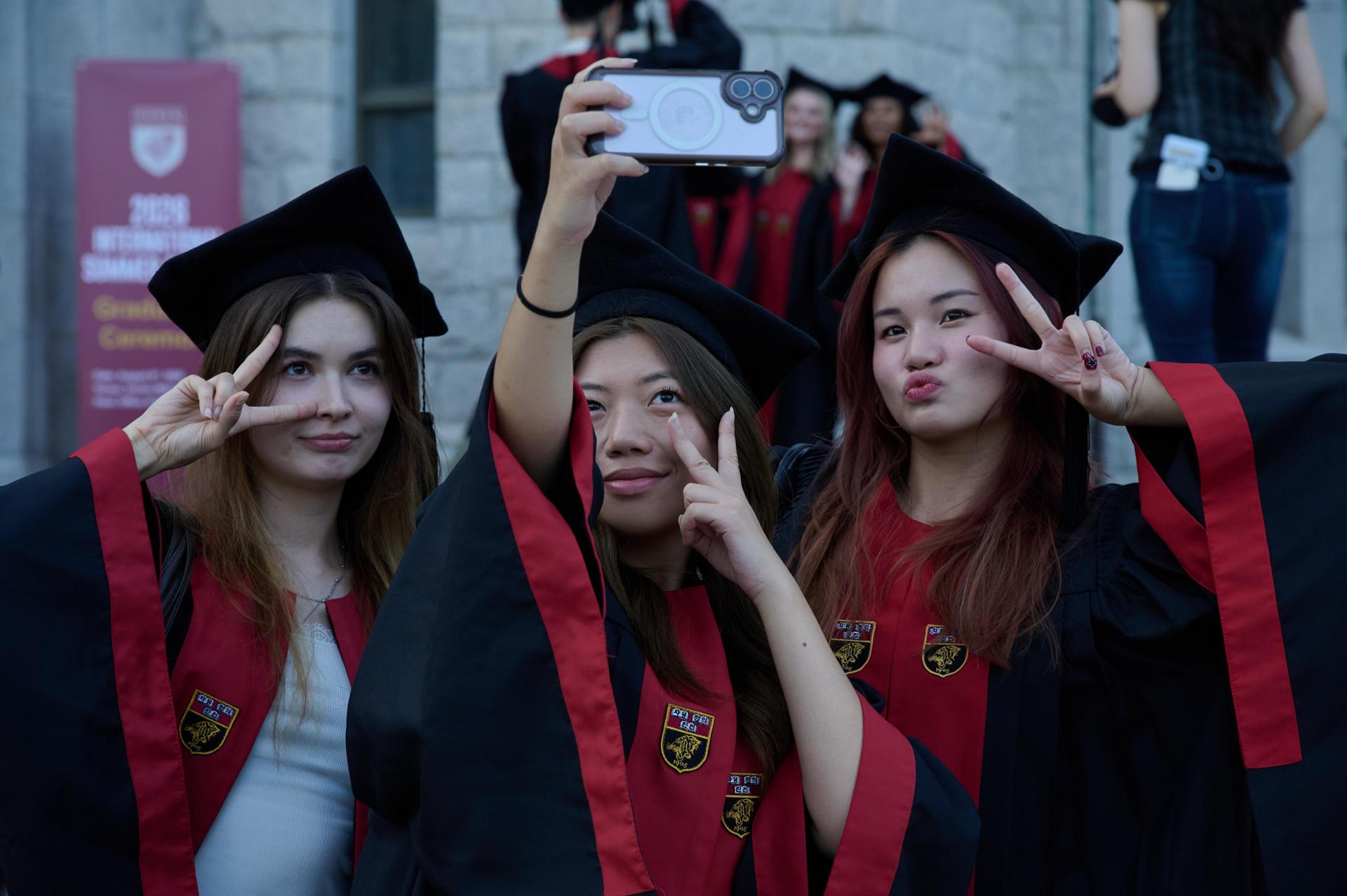
Korea University retained the top spot in The Korea Times University Rankings 2027 for the second consecutive year, as the country’s leading universities largely held their ground while Sejong University emerged as the biggest mover in the top 10
First launched last year, The Korea Times University Rankings aim to look beyond the number of international students to assess how well universities are building the broader ecosystem needed for globalization
This year’s results suggest that while Korean universities have made progress in attracting and managing international students, many still lag in areas such as international faculty, financial support and post-graduation outcomes
The disparity was evident across the four evaluation areas. Universities performed strongest in education, while scores were lower in student support and lowest in graduate outcomes, underscoring the challenge of building an environment that supports international students not only upon arrival but throughout their studies and beyond graduation
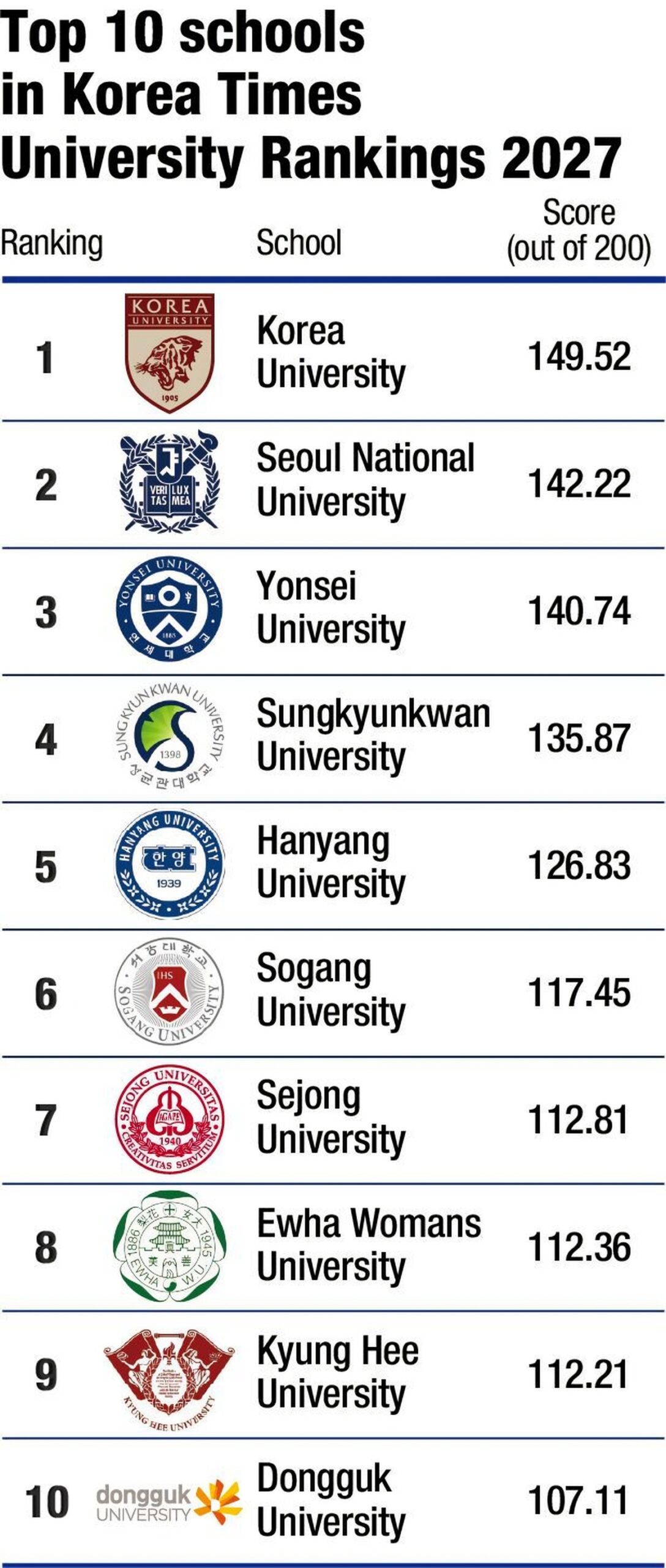
Korea University topped the rankings with 149.52 points out of 200, followed by Seoul National University with 142.22 and Yonsei University with 140.74. Sungkyunkwan University, Hanyang University and Sogang University rounded out the top six, with all six retaining the same positions as last year
Sejong University climbed six spots from 13th last year to seventh, breaking into the top 10. Its education score rose sharply from 32.8 points to 47.93, while it maintained its strong research performance with 39.6 points, remaining among the top performers in research for the second consecutive year
Meanwhile, the University of Seoul slipped four places from seventh to 11th. Its education score fell from 47.02 points last year to 41.41 this year, contributing to its decline in the overall rankings
Ewha Womans University, Kyung Hee University and Dongguk University completed the top 10, all retaining their positions from last year
While individual rankings shifted, there was little change in the universities making up the top 30 from last year. Yeungnam University in Gyeongsan, North Gyeongsang Province, and Kookmin University were the only newcomers, breaking into the top 30 after ranking outside the group
The results also highlighted a persistent regional divide in university globalization. Of the 30 universities recognized for excellence in globalization, 23 were located in Seoul, Gyeonggi Province or Incheon, while only seven were based elsewhere, suggesting that globalization capacity remains heavily concentrated in the capital region
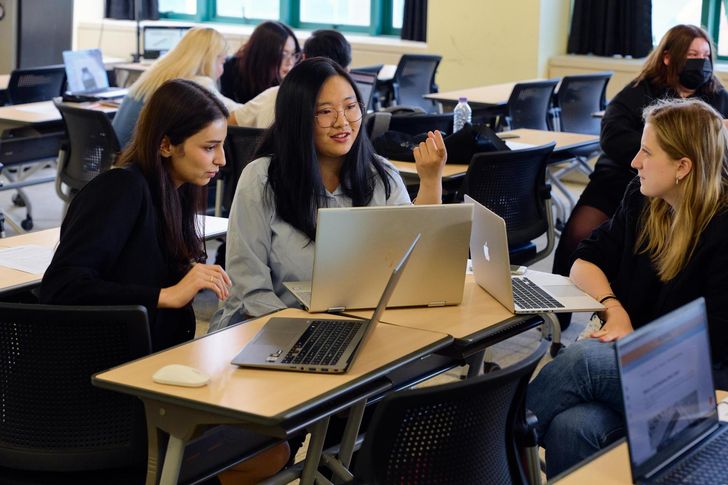
Shifting focus from quantity to quality
Amid the rapid growth of Korea’s international student population, the rankings are designed to serve as a guide for universities shaping their internationalization strategies while providing prospective international students with reliable information
As in its inaugural edition, the assessment places far greater weight on globalization than conventional university rankings, with 65 percent of the total score based on indicators directly related to globalization
This year’s evaluation also introduced several changes to sharpen that focus
It expanded to 60 universities from 54 last year, with the selection reflecting factors including university size, international student enrollment and the distribution of public and private institutions across the Seoul metropolitan area and other regions
The rankings also adopted a broader scoring framework, with 19 indicators worth a total of 200 points, up from 18 indicators and 190 points last year
A new 10-point indicator measuring the proportion of international full-time faculty was added this year, while the measure for international student retention was narrowed to degree-seeking students. Research performance was also assessed over a three-year period, up from one year, to better reflect universities’ longer-term research capacity
Experts viewed this year’s rankings as a meaningful improvement that maintained continuity with the inaugural assessment
“This year’s rankings showed progress in several areas, particularly with the addition of indicators measuring the ratio of international full-time faculty and international student retention rate,” said Shin Jang-sup, a professor of economics at the National University of Singapore. “The move to strengthen the evaluation framework for international students is also a positive step.”
Shim Hwa-yong, CEO of international student services platform Hirediversity, said this year’s rankings are broadly in line with the changing direction of Korea’s immigration policy
“Immigration policy is increasingly shifting toward regional areas, long-term settlement and quality management,” Shim said. “This year’s rankings reflect those priorities and represent a clear improvement in both validity and reliability from the inaugural assessment.”
This year’s rankings placed greater emphasis on how effectively universities manage globalization rather than simply how much they have expanded it
The shift drew a clearer distinction between universities that have relied heavily on the numerical growth of international students, including language trainees, and those that have focused on degree-seeking students and their ability to remain and succeed at the institution
The results ultimately point to the next challenge for Korean higher education: moving beyond enrollment growth to building campuses where international students and scholars can study, conduct research and build careers
The Korea Times plans to further refine the rankings, adding indicators on settlement infrastructure for international students and faculty and international research diversity next year, followed by international student satisfaction surveys and graduate outcome tracking in 2028
- Q.
- Q.
- Q.
Need help choosing the right university or study destination?
Start your FREE JIUniversity Admission Assessment today and discover the best international study pathway for your academic goals.
Source: www.koreatimes.co.kr
Tag:contenders, firm, hold, Korean, universities

You may also like
AI era puts philosophy in demand at Korea’s top universities

Imperial named University of the Year 2027 by The Times and Sunday Times