
Has Australia’s genuine student test gone too far?
Short on time? Here are the highlights:
- Rejection rates for student visa applicants for Australia have reached historical highs
- This reflects in part a greater scrutiny of student applicants across the Australian system
- Those more stringent assessments, in combination with a much higher visa application fee, now also appear to be discouraging more applicants from entering the process
Updated data from the Department of Home Affairs makes it clear that visa grant rates continue to trend downwards this year. In fact, approval rates for August were the lowest in the 20-plus-years of recorded history for which data is available
The student visa grant rate for primary applicants dipped to 75.5% in August 2026 – making that the lowest award rate since 2006/07 and one that is considerably below historical norms
August trends are part of a larger pattern where grant rates have been declining steadily in the years after the pandemic
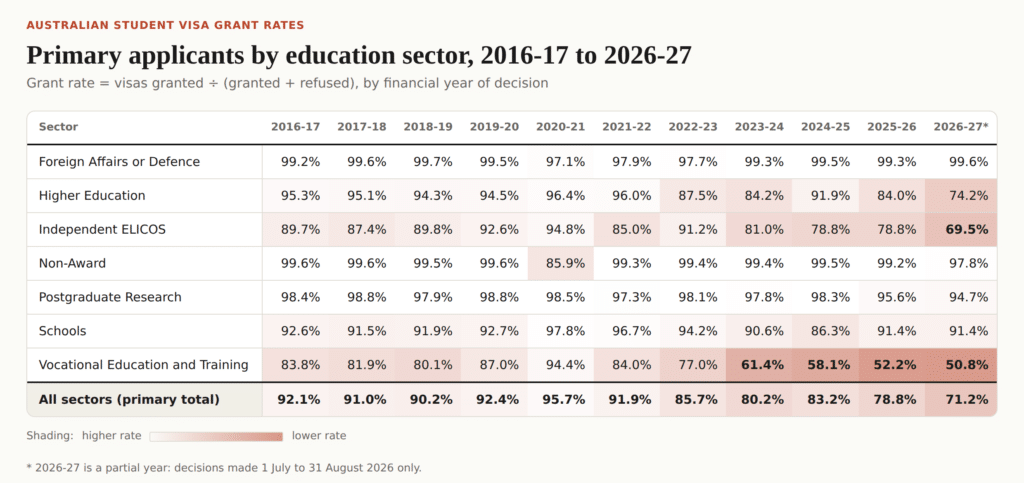
As shown in the table above, the grant rates vary by sector, with ELICOS and VET applicants particularly affected in the latter years
Visa grant rates also vary considerably by sending market, with Bangladesh, Bhutan, Colombia, India, Indonesia, Kenya, Nepal, Nigeria, Philippines, and Sri Lanka facing the highest rates of rejection
For example, only 34% of Bangladeshi offshore applicants (applying from outside of Australia) and 13% of Nepalis were successful in obtaining a visa in August. That compares to the 98% and 92% of applicants from each country who obtained a visa in August 2025
Just over half of Indian offshore applicants (51%) were awarded a student visa in August 2026 (this compares to the 72% that were successful in August 2025). Grant rates for Chinese applicants, meanwhile, remained significantly higher and more consistent: 92% for August 2026 and 95% for August 2025
The overall direction of travel here reflects in part the introduction of Australia’s Genuine Student (GS) requirement, which has applied to all student visa applications filed after 23 March 2024. The guidance on the Department of Home Affairs website sets out the GS requirement plainly:
“To be granted a student visa, all applicants must demonstrate that they satisfy the [Genuine Student] criterion
The online student visa application form asks the following…
- Give details of the applicant’s current circumstances. This includes ties to family, community, employment and economic circumstances.
- Explain why the applicant wishes to study this course in Australia with this particular education provider. This must also explain their understanding of the requirements of the intended course and studying and living in Australia.
- Explain how completing the course will be of benefit to the applicant.”
An additional important reference, Ministerial Direction No. 106, provides guidance to visa officers when evaluating applications against the Genuine Student test
That clear documentation, however, does not mean that decision-making around the Genuine Student test is always clear. Phu Vu Minh, a migration agent at VisaEnvoy, reflected the perspective of many stakeholders when, speaking to ABC News, she said the Department of Home Affairs provides “unreasonable” reasons in its refusal letters, which are often “vague.”
“It’s like copy-paste from one to the other,” she said. “It doesn’t … show that the case officer has carefully assessed all the evidence submitted together with the application.” Based on her experience, Ms Minh concludes that “the GS assessment [is] highly subjective to the case officer.”
“You may get approval from one case officer, but with the same case [or application] you may get refused by another case officer,” she added
Another factor bearing on visa grant rates are the Evidence Levels used within Australia’s Simplified Student Visa Framework (SSVF). These are essentially risk ratings that apply – on a three-step scale of EL1, EL2, and EL3, where EL1 represents the lowest risk level – to both sending markets and institutions. Depending on the combined risk level assessed to a given origin country and institution, the applicant may be required to furnish higher levels of evidence to support their student visa application.
Those Evidence Levels are periodically reset, and the latest review cycle has just concluded with new settings in place as of 30 September 2026. The latest ratings have 19 Australian universities at EL1, and 22 at EL2. A related report in Times Higher Education notes that, “Six of Australia’s top ten source countries for international students – India, Nepal, Bangladesh, the Philippines, Colombia and Pakistan – are now ranked high risk by the Department of Home Affairs … Another three – Vietnam, Indonesia and Sri Lanka – carry medium-risk ratings.”
In combination, the Genuine Student requirement and the more stringent Evidence Level settings reflect a pattern of greater scrutiny of student visa applicants by Australian officials
The Australian government has also been fairly aggressive in raising visa application fees. The latest increase, from July 2026, brought the fee for most applicants to AU$2,500 (AU$2,050 for ELICOS students). This stands, by a considerable margin, as the most expensive application fee anywhere in the world
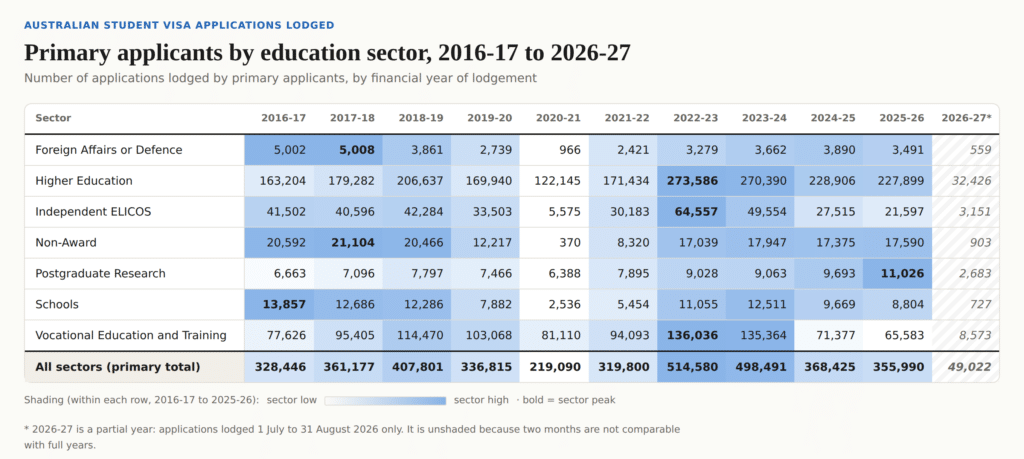
This combination of shifting risk assessments, opaque tests of genuineness, and sky-high visa fees has had the predictable effect of depressing demand at the top of the enrolment funnel. Visa application volumes have been falling since 2023/24, as we see in the table below
For additional background, please see:
- “Australia moves to reduce net migration with new restrictions on student family members and ‘visa hopping'”
- “Australia: Decline in international higher education commencements projected for 2026”
- “Australia: As visa applications from foreign students fall, the government has set the national target for new international students in 2027”
- “Surprise hike in international student visa application fees ‘a direct hit to Australia’s competitiveness'”
Most Recent
- Seven predictions for international student recruitment in Latin America
- Getting past “good enough” in responding to prospective students
- Has Australia’s genuine student test gone too far?
Most Popular
- Which countries will contribute the most to global student mobility in 2030?
- Research shows link between study abroad and poverty alleviation
- Beyond the Big Four: How demand for study abroad is shifting to destinations in Asia and Europe
Need help choosing the right university or study destination?
Start your FREE JIUniversity Admission Assessment today and discover the best international study pathway for your academic goals.
Source: monitor.icef.com
Tag:Australias, genuine, gone, Student, test