The UK must join Europe’s open access platform—or miss out – Research Professional News
Image
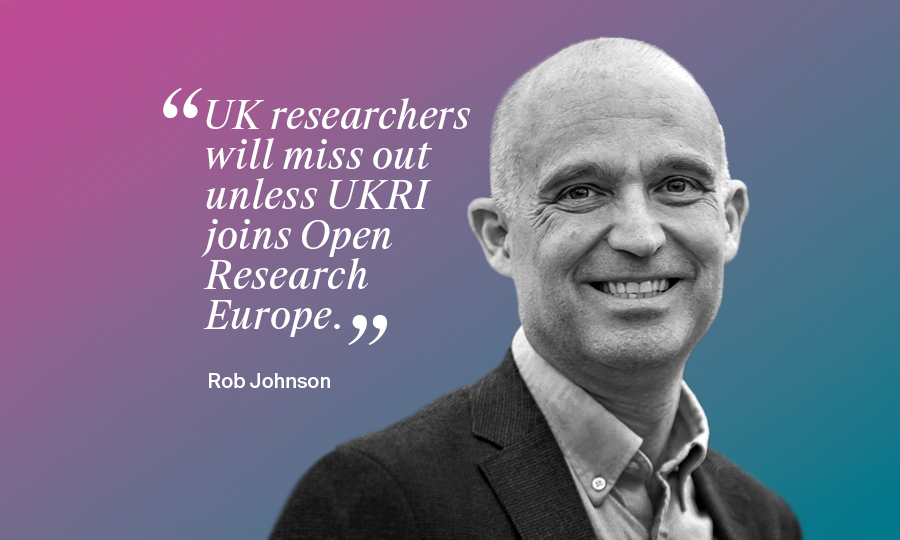
Ending hybrid funding without backing Open Research Europe will hit UK researchers, says Rob Johnson
The four largest commercial academic publishers—Springer Nature, Elsevier, Taylor & Francis and Wiley—all have open access volume growth baked into their forward earnings guidance. However, I find it increasingly hard to square this need for growth with the rhetoric emerging from research funders and policymakers
As funders across the world invest in alternatives to hybrid open access, UK researchers will miss out unless UK Research and Innovation (UKRI) joins Open Research Europe (ORE), a no-fee, collectively funded open access publishing platform
Hybrid open access (where individual articles are made open access in subscription journals) has functioned mainly as a mechanism for transferring research budgets to commercial publishers’ bottom lines. Springer Nature is launching a new fully open access journal series, and pay-to-publish models account for a growing share of scientific, technical and medical revenue in Elsevier’s parent company Relx. Taylor & Francis reports that open research volumes continue to grow strongly in 2026, while Wiley says its author-funded open access model is growing consistently above 20 per cent per year.
The rapid upsurge in article submissions driven by generative artificial intelligence is feeding this model, but it is under pressure. Politicians at an April congressional hearing in the US criticised commercial publishers’ profits, and the 2027 White House budget request asks Congress to end the use of federal funds for “expensive subscriptions to academic journals and prohibitively high publishing costs”.
The Chinese Academy of Sciences is halting payments for journals charging above $5,000 (£3,700), and the Swiss National Science Foundation (SNSF) will cap publication charges at 3,500 Swiss francs (£3,320) from January 2027, well below the typical article-processing charge (APC) at high-prestige journals
Funding changes for the UK
UKRI, the UK’s national funder, recently confirmed that it will no longer fund hybrid open access charges from 2028-29, while continuing to back other routes to open access. The distinction matters: UKRI is closing down the model where universities risk paying twice—once for subscription access and again for open access publication—but is not retreating from open access itself. Cancer Research UK has gone further still, describing the current arrangements as unsustainable and ending all APC support from October 2026.
Funders are not simply walking away from APC-driven open access; they are increasingly investing in the alternatives. UKRI’s announcement promised targeted investment in green open access repository infrastructure. Philanthropic funders in the US like the Gates Foundation and the Howard Hughes Medical Institute are supporting early sharing of research through preprints. China is funding domestic journal capacity at scale. And in Switzerland, the SNSF is joining the next phase of ORE.
ORE was launched in 2021 as a no-fee publishing route for researchers holding EU grants, backed by European Commission funding. I produced the scoping and funding scenario reports for ORE in 2022 and 2023. The next phase scales ORE from a single-funder platform into a multi-jurisdictional infrastructure across the European Research Area. ORE sits between diamond open access and APC-funded gold: collectively underwritten by participating funders, free to authors whose funders support the model, and free to read for everyone.
Time to participate fully
The UK is not yet a participant. UKRI and the UK higher education IT agency Jisc have backed Octopus, a UK-developed platform with a different proposition focused on structured research outputs, which deserves continued investment on its own terms. But Octopus is not a substitute for traditional journals in the eyes of most researchers, and the UK currently has no route into the open access infrastructure that other European funders are pooling resources behind.
UK-based researchers holding grants from the EU’s Horizon Europe research and innovation programme are currently among the heaviest users of the ORE platform, behind only Germany and Spain. But that route will be closed to the much larger UK research community funded by UKRI and other domestic
Closing off hybrid funding while declining to back ORE risks a worst-of-both-worlds outcome: researchers losing one route while gaining no credible replacement
UK government policy favours closer EU alignment, and UKRI’s own open access policy is consistent with the kind of participation ORE represents. While ORE won’t supplant large commercial publishers any time soon, the upfront cost would be small compared with the savings from defunding hybrid open access, and it would allow the UK a say in shaping the platform
The harder question is who will pay for sustainable open access at scale. Researchers will keep submitting and volumes will keep growing. Cash-strapped <a href="https://jiuniversity.com/santa-clara-university-rises-in-national-rankings/” title=”Santa Clara University Rises in National Rankings”>university libraries are unlikely to take up the slack. Which leaves the choice that the post-APC era will be defined by: will green and diamond open access finally come to the fore, or are we heading back to subscriptions by another name?
Rob Johnson is founder and managing director at Research Consulting
Need help choosing the right university or study destination?
Start your FREE JIUniversity Admission Assessment today and discover the best international study pathway for your academic goals.
Source: www.researchprofessionalnews.com

You may also like