Visa delays and policy uncertainty projected to reduce foreign enrolment in the US by more than 100,000 students this fall
Short on time? Here are the highlights:
- Visa delays and new rules affecting international students could result in a reduciton of up to -9.5% in overall foreign enrolment in the US for 2026/27
- That decline in international student numbers could cost the US economy as much as US$3.4 billion and affect up to 39,000 jobs
- Stakeholders are urging the US administration to prioritise student visa processing in the weeks leading up to the start of the academic year
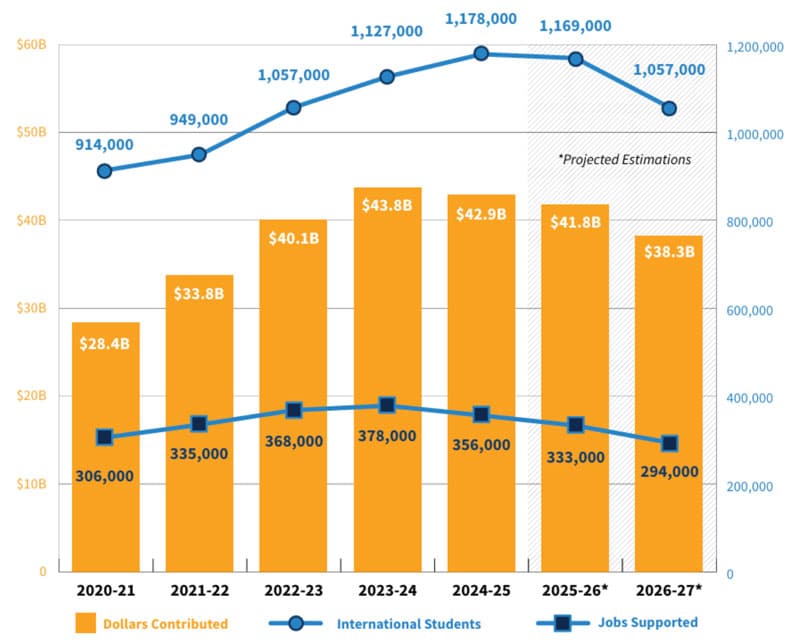
A new analysis from NAFSA and JB International projects that ongoing disruptions in visa processing, along with new policy settings planned for the coming year, will have a “devastating effect” on international student numbers in the United States for the coming year
Based on institutional responses in IIE’s Spring 2026 Snapshot on International Educational Exchange, the estimate is for a 9.5% decline in overall foreign enrolment in the US in fall 2026. This could result in an enrolment decline of up to 110,000 students at US colleges and universities. In economic terms, that translates to up to US$3.4 billion in lost spending and 39,000 jobs affected
“The projections underscore what we’ve long warned,” said Fanta Aw, Executive Director and CEO of NAFSA. “US policy and regulations affect where international students plan to invest their future—and their decisions carry significant short- and long-term consequences for US society and economy, All Americans lose when international students and scholars are driven to more welcoming countries.”
The analysis points to three major factors behind the projected decline in enrolment for 2026/27: reduced or diverted demand; process and policy around student visas; and policy uncertainty
There are a number of indicators of declining demand for study in the US this year, whether those students are simply deferring their study plans or choosing an alternate destination. First, recent findings from the Association of American Universities Data Exchange highlight that the international pool of doctoral candidates shrunk by -21% for 2026/27, a trend that led to an overall decline in international PhD admissions of -17%. Meanwhile, the Common App says that international applications filed via its college admissions platform are down -9% for the coming academic year. And, as we reported recently, nearly two-thirds of respondents to IIE’s Spring Snapshot Survey are expecting enrolment declines for 2026/27.
Those trends are no doubt influenced by a series of underlying issues around student visa processing. An expanded ban on travel to the US affecting citizens from 39 countries, including Nigeria, has been in place since 1 January 2026. While there has not been an outright pause on visa processing this year, the State Department’s prioritisation of visa processing for FIFA World Cup ticket holders traveling to the US supplanted the historical norm of prioritising student applicants during the peak processing months over spring and summer. Making the situation even more challenging, there are widespread reports of significant processing delays and very limited visa interview availability in India, China, and Europe.
Finally, both announced and anticipated rule changes are combining to create additional uncertainty for international students in the US this year. A new rule will come into effect on 15 September 2025 to replace the longstanding “Duration of Status” framework with a fixed Admit-Until-Date (AUD). The new AUD mechanism sets a maximum limit for which a student visa can be granted, and requires continuing students to apply for an extension with US immigration officials. This, says NAFSA, creates “significant planning uncertainty for prospective students, particularly those considering longer-degree programmes,” and an issue which is compounded by “the current administration’s continued warnings that it intends to reform the Optional Practical Training programme.”
“Forfeiting the US position as the top destination for global talent hurts students, hospitals, research laboratories, the economy – and carries the real risk that the next big invention will not happen on US soil,” adds Dr Aw. “We urge the administration and Congress to take swift action to ensure international student contributions continue to benefit American ingenuity, economic prosperity, and national security.”
In order to ease the projected decline for 2026/27, NAFSA is urging the US administration to take the following steps
- Prioritise processing for all F and M visa applicants as well as for those pursuing a J visa for exchange in the US;
- Exempt students and exchange visitors from the current travel ban “while maintaining background checks and vetting required for visa issuance”; and
- Preserve Optional Practical Training for foreign graduates in the US.
For additional background, please see:
- “Decline in Indian demand a major factor in softer outlook for foreign enrolment in US higher education in 2026/27”
- “Updated: US Department of Homeland Security publishes rule to end Duration of Status for international students”
- “US regulatory agenda for 2026 aims to end ‘duration of status and introduce Optional Practical Training and H-1B reforms”
- “US extends travel ban, Nigeria now included on ‘restricted’ list”
Most Recent
- UK Home Office revokes Bloomsbury Institute’s student sponsor license
- Visa delays and policy uncertainty projected to reduce foreign enrolment in the US by more than 100,000 students this fall
- After years of growth, Korea faces the challenge of better integrating and retaining international students
Most Popular
- Which countries will contribute the most to global student mobility in 2030?
- Research shows link between study abroad and poverty alleviation
- Beyond the Big Four: How demand for study abroad is shifting to destinations in Asia and Europe
Need help choosing the right university or study destination?
Start your FREE JIUniversity Admission Assessment today and discover the best international study pathway for your academic goals.
Source: monitor.icef.com
Tag:delays, policy, projected, uncertainty, visa