What It’s Like to Study Nutrition at Tufts in Talloires, France

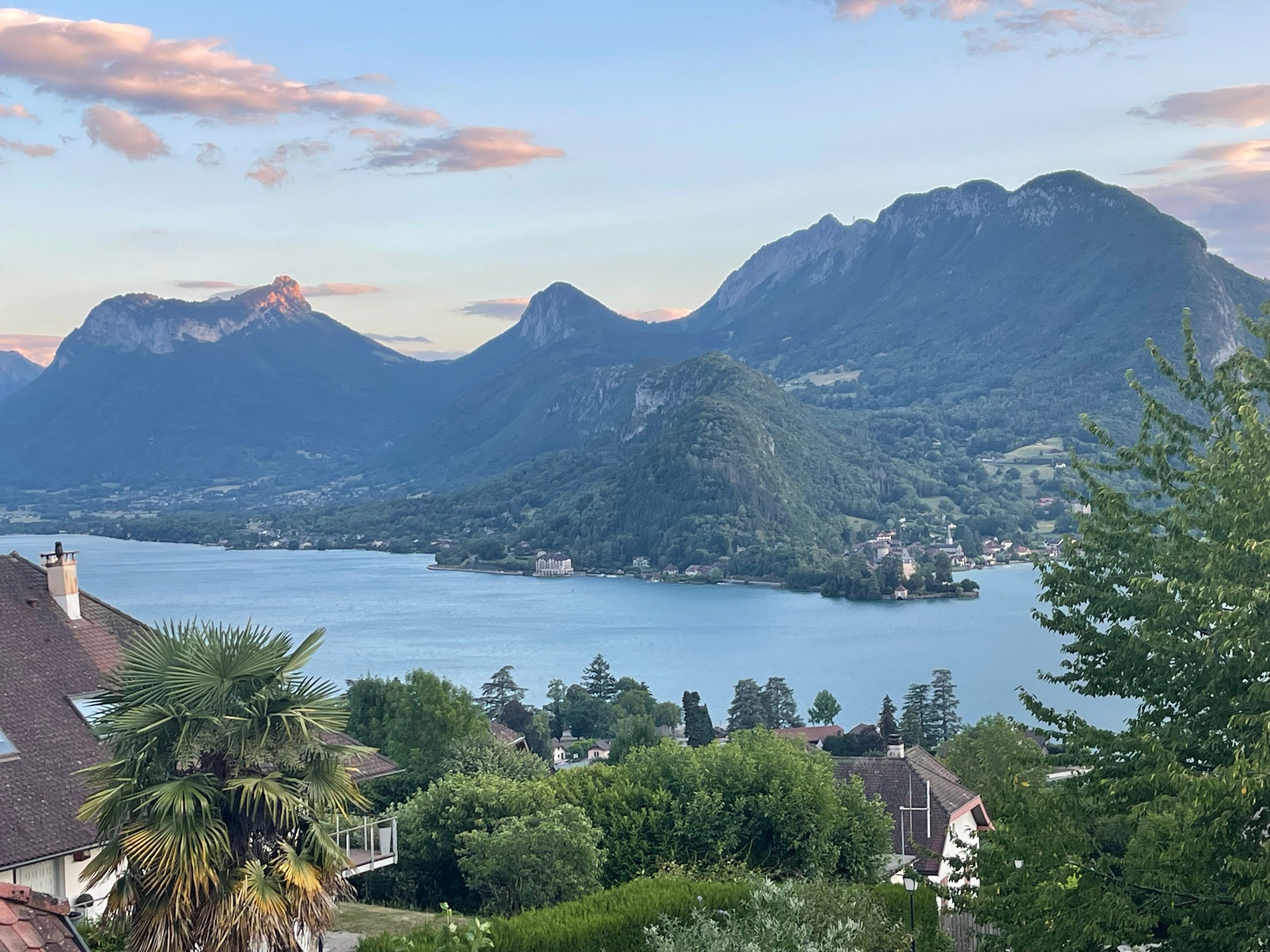
Talloires is a village located in southeastern France on the shore of Lake Annecy and at the foot of the French Alps.
Photo: Courtesy of Kim Dong
Food & Nutrition
What It’s Like to Study Nutrition at Tufts in Talloires, France
Food stalls piled high with the season’s freshest produce lined both sides of the narrow, winding cobbled streets of Annecy, France. Boxes of deep green zucchini and tomatoes in every shade of yellow, red, orange, and purple. Melons, beans, carrots, artichokes, leeks. Cured meats were hung from rafters and laid bare in thin slices, begging to be sampled by passersby. And then there was the cheese. Wheel upon wheel of hard, soft, yellow, orange, blue, moldy, melty cheese stacked high like wedding cakes.
“Bonjour! Parlez-vous anglais?” a Tufts student asked one of the vendors
“Mais, oui! Of course! Where are you visiting from?” he asked
“I’m here for two weeks with a group from Tufts University in Boston,” they said. “We’re taking a course on global nutrition.”
“Nutrition? In Talloires?! Have they told you how much we like our cheese? Here, please try some, you will see.”
The vendor gestured to the array of cheeses arranged in towers on his stall. Gooey Reblochon with its saffron-tinted rind. Fuzzy gray-brown Tomme de Savoie with its buttery pockmarked interior. Large yellow-orange wheels of Raclette, the same kind being melted and scraped over sandwiches on every side street in theVieille Ville.
The student reached out to try a sample. They tasted alpine sunshine and Savoie meadows and the rich cream of cows milked first thing in the morning. “Merci, monsieur. C’est magnifique!”
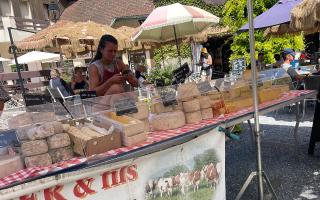
Food stalls displayed different types of cheese for sale in Talloires, France.
Photo: Courtesy of Kim Dong
For two weeks in July, six graduate students fromTufts University School of Medicine Public Health programsand the Gerald J. and Dorothy R.Friedman School of Nutrition Science and PolicyaccompaniedKim Dong, associate professor at both schools and a registered dietitian, to the Talloires region of France for an accelerated three-credit course called Global Nutrition in Action. It marked the first program offered through theRibbons of Impactproject that aims to provide more such experiential learning opportunities to students at Tufts.
The course was developed as an immersive learning experience into the food systems and culture of France while examining planetary health and climate change through the lens of nutrition and public health
“In the Talloires, there’s a deep connection with agriculture, the producers of food, bringing food to the markets, and connecting with people in the community,” Dong says. “The students got to learn firsthand about French culture and the pride they take in the localness of their food.”
Beyond exploring the vibrant farmers markets in the region, students participated in a variety of excursions. The class met with university faculty working on immigrant nutrition and public health in Geneva, Switzerland; learned about alternative protein from a representative of the Good Food Institute; and, during one of the highlights of the trip, visited theUnited Nations Office at Genevawhere they met with a representative of the U.N. Food and Agriculture Organization (FAO) who discussed global nutrition programming and the challenges they face in the current global aid landscape.
In the day-to-day, students shopped at the hypermarché (supermarket), a stark contrast to the supermarkets in the U.S., and dined out at restaurants where phones were noticeably absent at the table. Throughout the two weeks, the class was guided by staff at theTufts European Center, who acted as their on-the-ground local experts. Director Gabriella Goldstein and Assistant Director Nelson Millán Nales led students around the region, introducing them to a baker of a long-running intergenerational bakery and a local cheesemaker, among others.
Nitya Koduri, M29, a student in theMD/MPH dual-degree program, noted that being able to contrast the grand scale of the goals of the U.N. FAO with the small-scale lived experiences of running a family farm illustrated to her the impact that both ends of the spectrum have on our everyday health and nutrition. From the slow pace of life to the two-hour lunch break, she and other students were struck by just how much culture and lifestyle influence food choices in France.
“I wanted field experience to see how global nutrition is influenced by local and international factors,” she says. “In my future career, I hope to be able to guide patient nutrition in ways that are adaptable to their culture by keeping in mind that so many factors play a role.”
Amidst the excursions and coursework, she said one of the most rewarding parts of the program came from working with such a small group of like-minded students, all of whom came from different personal and professional backgrounds and academic programs. Being exposed to agriculture and food production for the first time together helped the participants develop fast bonds they hope carry on well past the program.
Grant Nelson, a graduate student in theMaster of Science in Nutrition programspecializing in humanitarian assistance, has a Ph.D. in health psychology and behavioral medicine. He built a successful career as a psychotherapist before returning to school with a focus on nutrition. Like Koduri, he felt that everyone in the class learned as much from each other as they did from the coursework and excursions.
“Could you teach this course in a classroom? Easily. Would it have the same effect? Not at all. And it’s not just because we were in this beautiful place in France. It’s the fact that we went way outside of our comfort zone,” Nelson says
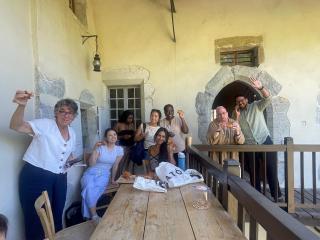
The participants, all of whom came from different personal and professional backgrounds and academic programs, developed fast bonds they hope carry on well past the program.
Photo: Courtesy of Nitya Koduri
At the end of the two weeks, the students participated in an immersive field experience by joiningDavid Kaplan, Stern Family Endowed Professor of Engineering and director of theTufts University Center for Cellular Agriculture, at the Future of Food conference hosted at the Tufts European Center in Talloires. The conference provided a dynamic forum for discussions on how next-generation foods can help to address human, animal, and environmental health. It allowed the students to network with experts and apply what they’d learned throughout the accelerated course to real-world efforts of improving global nutrition.
“It made a huge difference to be able to take this accelerated course, then bring everything we learned right into the conference,” Nelson says
After meeting representatives of the U.N. and networking with experts at the conference who encouraged him in his career plans, Nelson says he was filled with a sense of hope that there would be a place for him in the professional world when he graduates. If anything, the program made him even more committed to his career trajectory
Upon returning to Boston, the students have yet another opportunity to expand upon what they learned in France. Each student will be working one-on-one with Dong to develop and execute an integrative culminating project that connects classroom knowledge with real world insights
After leaving France, Koduri visited her family and was able to immediately contrast her own South Asian culture with what she had just learned in France before returning to Boston. She will be tying all three cultural perspectives on food into her culminating project. She intends to conduct focus groups with a local South Asian community center in Boston to better understand their attitudes and beliefs around food, health, and nutrition. Based on those qualitative data, she will conduct a tailored community intervention based on their needs.
Nelson’s project will tie in his previous experiences in the Philippines with his newfound knowledge of culture’s role in nutrition. He hopes to use a farm at a university in the Philippines he is familiar with as a case study for understanding the barriers to success and potential avenues for intervention
Looking back on the experience, Dong recalls one particularly poignant moment that epitomized the connection between culture and nutrition. When a doctor came to speak to the class about local diet-related health conditions, he spoke of the same ones afflicting people in the U.S.—high cholesterol, high blood pressure, diabetes. He said that health officials have been trying to encourage the French people to eat less dairy because of the saturated fat related to such conditions.
Culturally, however, eating less cheese is simply a non-starter. No one comes between the French and theirfromage
Need help choosing the right university or study destination?
Start your FREE JIUniversity Admission Assessment today and discover the best international study pathway for your academic goals.
Source: now.tufts.edu

You may also like

For our children in private universities in Benin and Togo